Philip Bartko Jr., Author at Cheekwood - Page 7 of 11 | Page 7
x icon Close
test

Sowing Seeds and Spilling Beans: Harvesting Okra
Okra Image 2_iOS

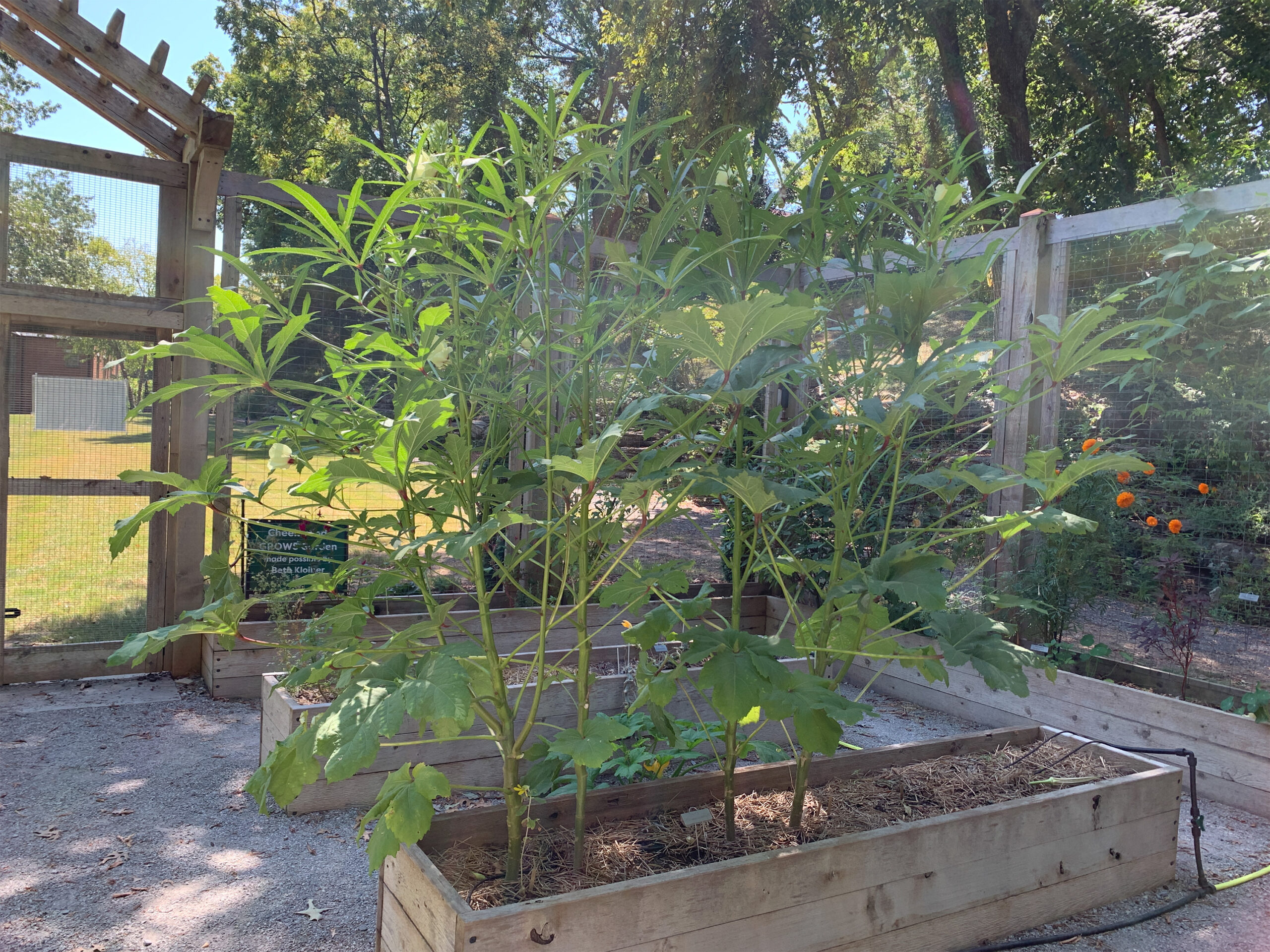
Featured Image: Okra plants in the Cheekwood GROWS Garden.

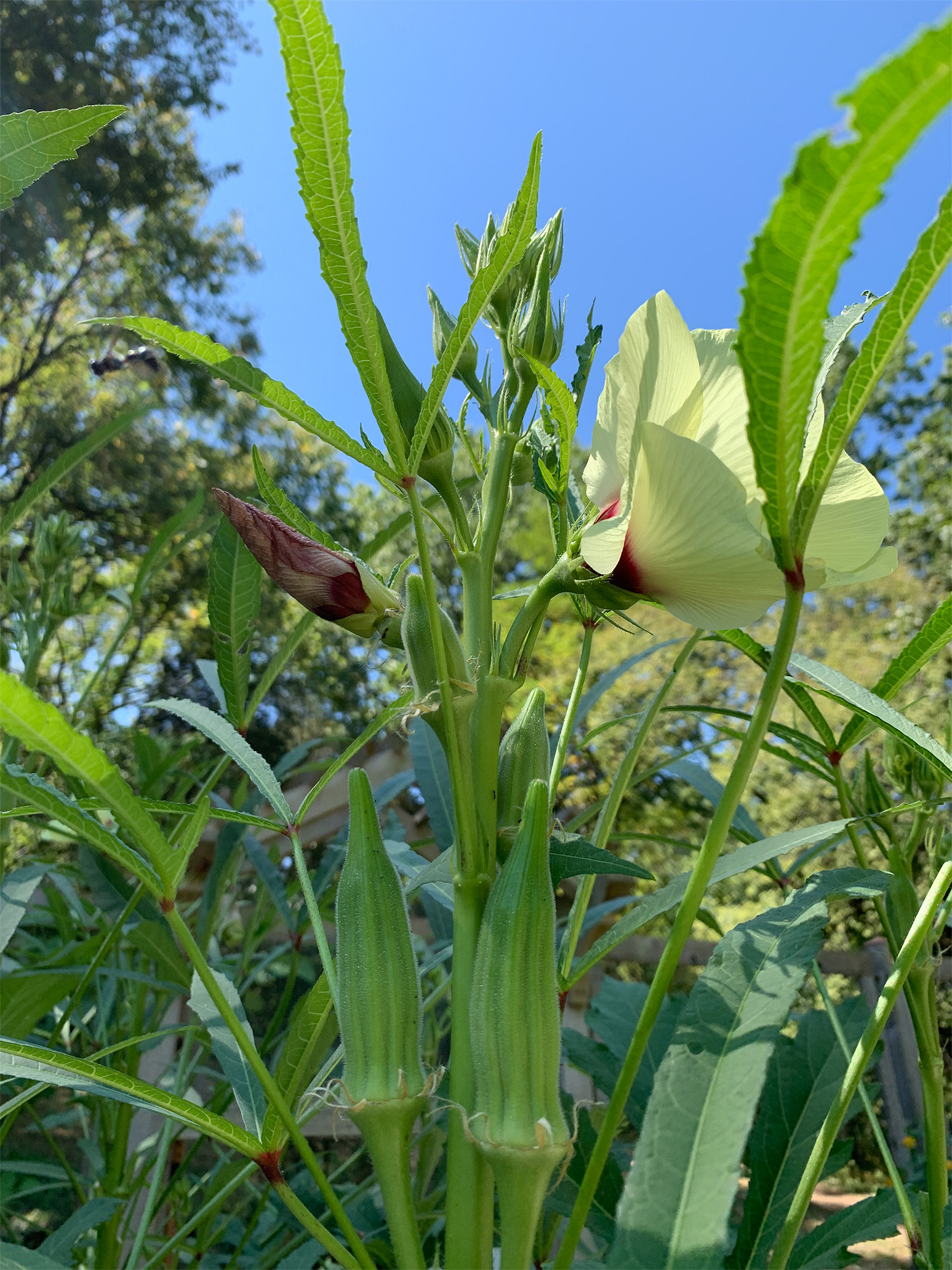
Okra fruits emerging on the plant.

Hello readers!

My name is Natasha, and I’m the Garden Educator at Cheekwood. My work here involves managing a raised bed vegetable garden (the Cheekwood GROWS Garden) and leading educational programming in this space. I’m excited to be starting this monthly blog series, in which I hope to explore cultivated edible plants and our relationships with them in Middle Tennessee.

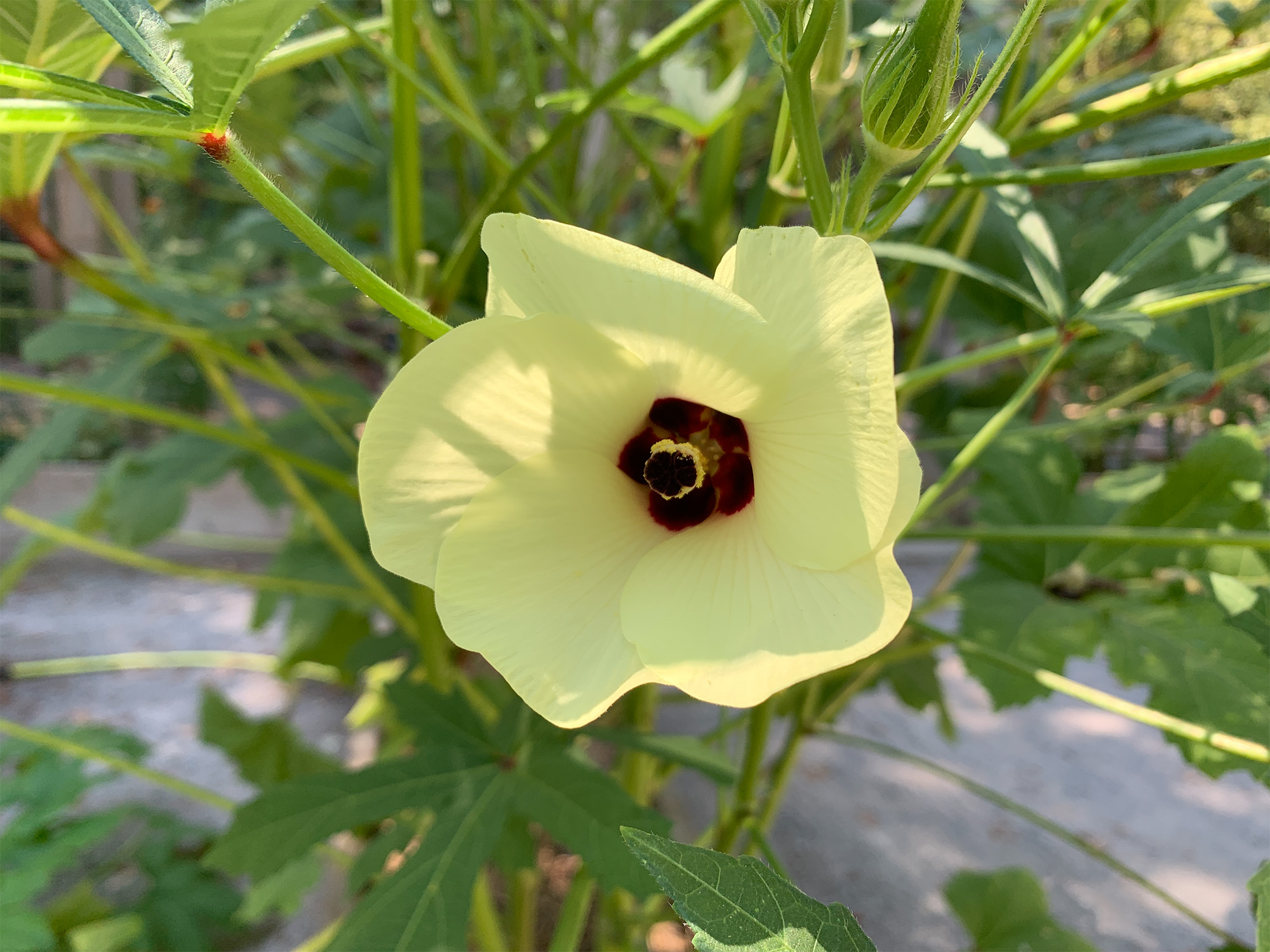
As summer begins to wind down, I have been thinking a lot about okra (Abelmoschus esculentus). A member of the mallow family (Malvaceae), hibiscus, cotton, and cacao are among its relatives. With its vigorous growth habit and ephemeral, red-tinged flowers, okra is a joyful plant. It thrives in heat, tolerates poor soil, and rarely faces significant pest or disease issues. The flowers only bloom for a single day, after which they quietly fall off the plant to reveal tiny fruits emerging behind them. Okra stands tall and strong with no staking necessary and will produce an abundance of these tasty fruits that can be prepared and eaten in countless ways – provided you catch them before they turn woody and tough, a change that will occur before you know it (i.e., in 4-5 days)!

Okra has ancient origins. The plant was first collected from the wild and cultivated over 3,000 years ago in the Abyssinian center of origin – a region encompassing present-day Ethiopia and parts of Somalia, known as an ancient agricultural hotspot. Wheat, sorghum, broad beans, and coffee are other significant crops now grown around the world that can be traced back to this biodiverse center of origin.

From there, okra spread around the world. It is an important ingredient in cuisines throughout the Indian subcontinent, the Middle East, and West Africa. It was enslaved Africans who brought okra – along with thousands of years of agricultural and culinary tradition –  to North America as a means of cultural preservation and survival. They grew the plant as a food crop in the American South, where it thrived in the rich soils and heat just as it did in its place of origin. Okra quickly became a staple of Southern cuisine and important food crop of the African diaspora.


Distinct okra recipes developed across the South in response to diverse cultural influences, from Creole gumbo in Louisiana to the okra and tomato stew of the Gullah Geechee people along the Southern Atlantic coast. Something that all okra recipes contend with in one way or another is one of its unique botanical features: the slime it secretes when cut open. The scientific term for this gelatinous substance is mucilage, and it acts as a lubricant to help okra plants efficiently transport and utilize water – a definite advantage in hot weather.

In gumbo, the slime acts as a thickener, giving the dish its signature mouthfeel. Pickling okra achieves the opposite effect, as the acidity from the brine cuts the gooeyness of the slime. Fried okra lands somewhere between these two; exterior crunch and interior slime balance each other out. I am a fan of all three, and welcome okra’s unusual mouthfeel as something truly unique among the vegetables widely available in this country.
Okra Image 3_iOS

Okra flower up-close.


As mentioned earlier, okra has a short harvest window and is best picked when the pods are about 3 inches long. I, however, have forgetful gardening tendencies and collected pods of all sizes this growing season. The slightly larger pods are still delicious but benefit from a longer cooking time; I like to halve them lengthwise and roast them in the oven. The very large pods contain jumbo white seeds – these can be removed and gently toasted in a pan with seasonings of your choice for a tasty snack! Okra is also perfectly edible, and in fact very delicious, freshly picked off the plant. It has a wonderful crunch that tends to fade during cooking.

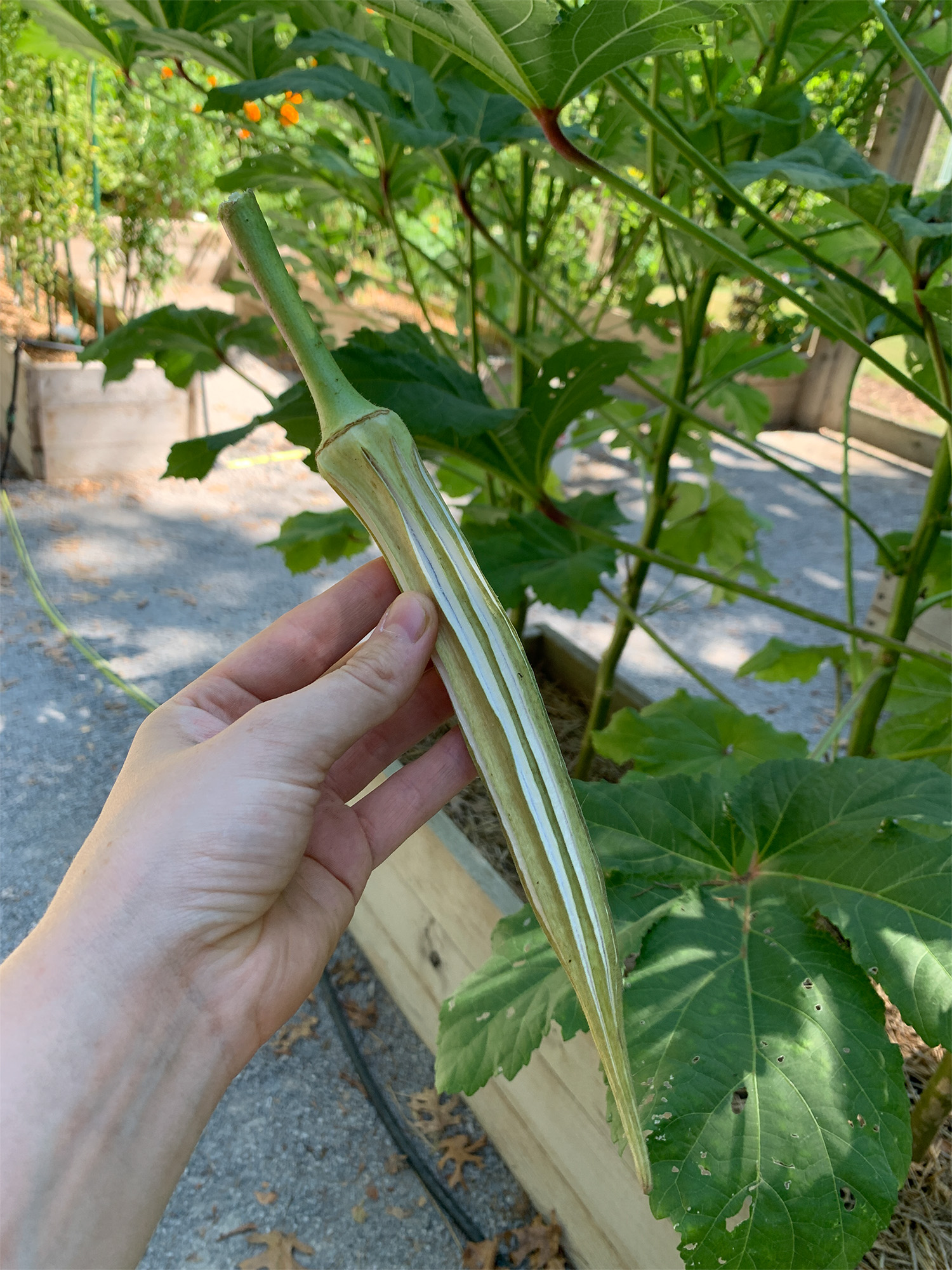
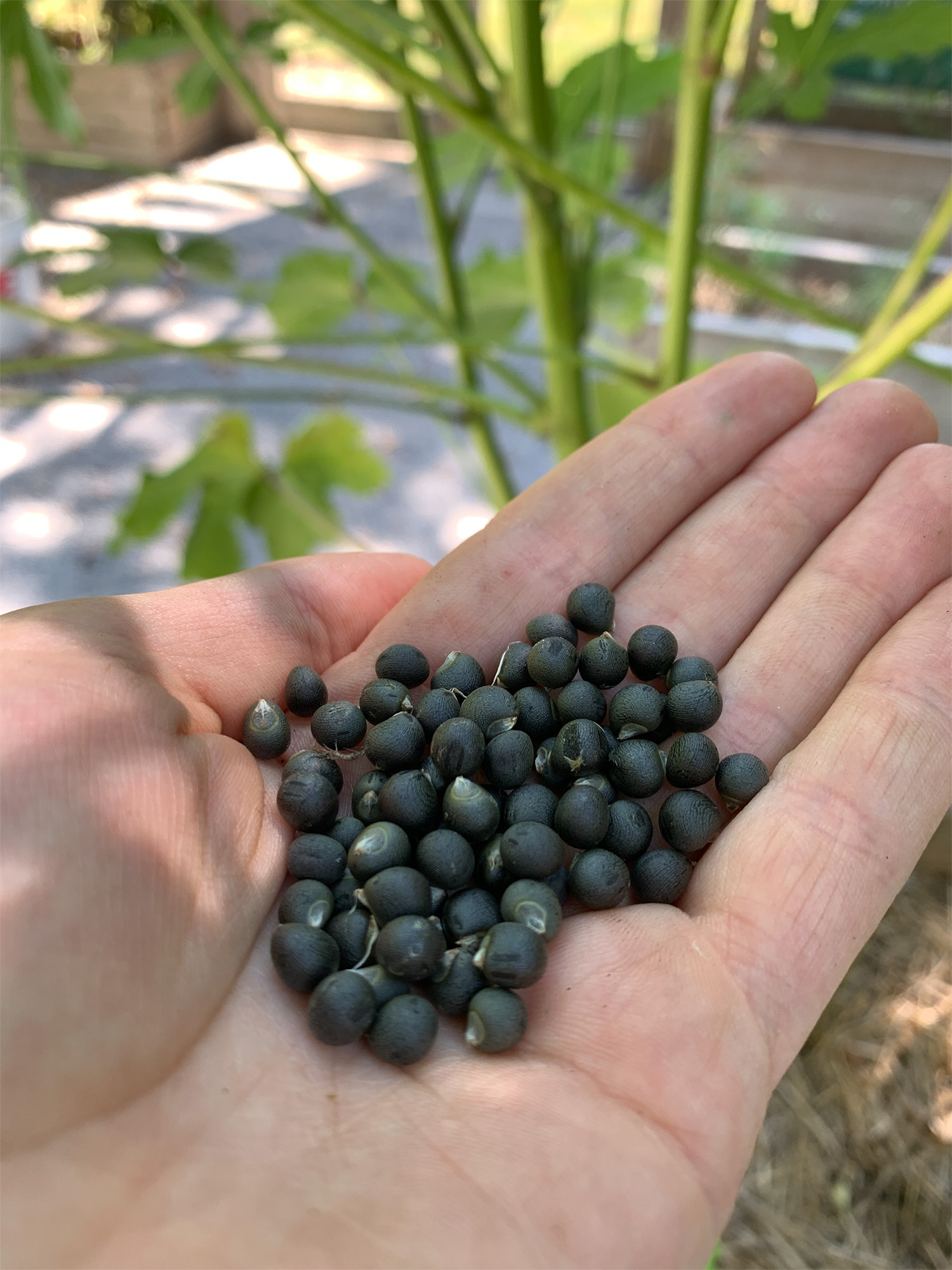
If you hope to save okra seeds for the following year, leave a few pods on your plant to grow huge and dry out. Towards the end of the summer, the ridges on these pods will become more pronounced and the green color will fade to white in between these ridges. At this point, you can harvest the pods, split them lengthwise, and remove the seeds within. You’ll know that they’re ready to save because they’ll have turned from a pearly white to a deep, green-tinged black. Since okra flowers are self-pollinating (both male and female parts exist in a single flower), the seeds you collect should produce the same variety you grew originally. Happy gardening!
Okra Image 4_iOS

Okra fruit that has dried out on the plant.
Okra Image 5_iOS

Okra seeds collected from dried-out pods.


Quick Fridge-Pickled Okra

Makes one 16-ounce jar

Ingredients

  • 8 oz fresh okra (10-15 pods, depending on size)
  • 3 cloves garlic, peeled and smashed
  • 1 fresh chile, split lengthwise, or 1-2 tsp dried chile flakes
  • 1 sprig fresh basil
  • 1 tsp black mustard seeds
  • 1 tsp black peppercorns
  • 1.5 tbsp granulated sugar
  • 1 tbsp kosher salt
  • 1 cup white vinegar
  • 0.5 cup water

Instructions

  1. Combine vinegar, water, sugar, and salt in a small saucepan. Simmer on the stovetop until sugar and salt have dissolved completely.
  2. In a clean, 16 oz mason jar, add okra, garlic, chile, basil, mustard seeds, and peppercorns.
  3. Pour heated brine over the vegetables and seasonings to fill the jar.
  4. Let the jar come to room temperature, then seal and refrigerate for at least 48 hours.
  5. Enjoy!

Thank you for reading my very first blog post.

If you have questions, comments, or suggestions for future topics, you can contact me at ngibbs@cheekwood.org.
test

2024 Summer Intern Blog


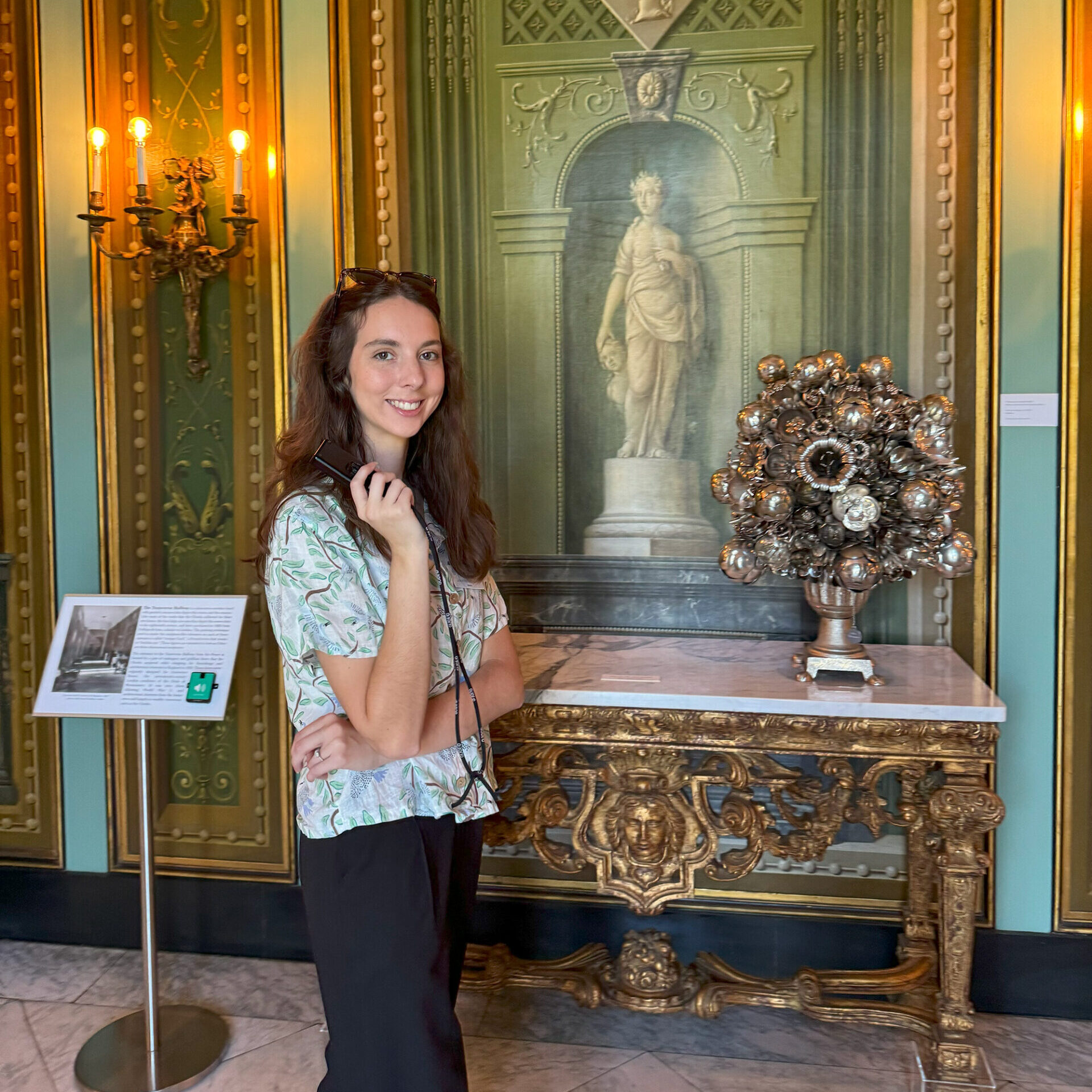
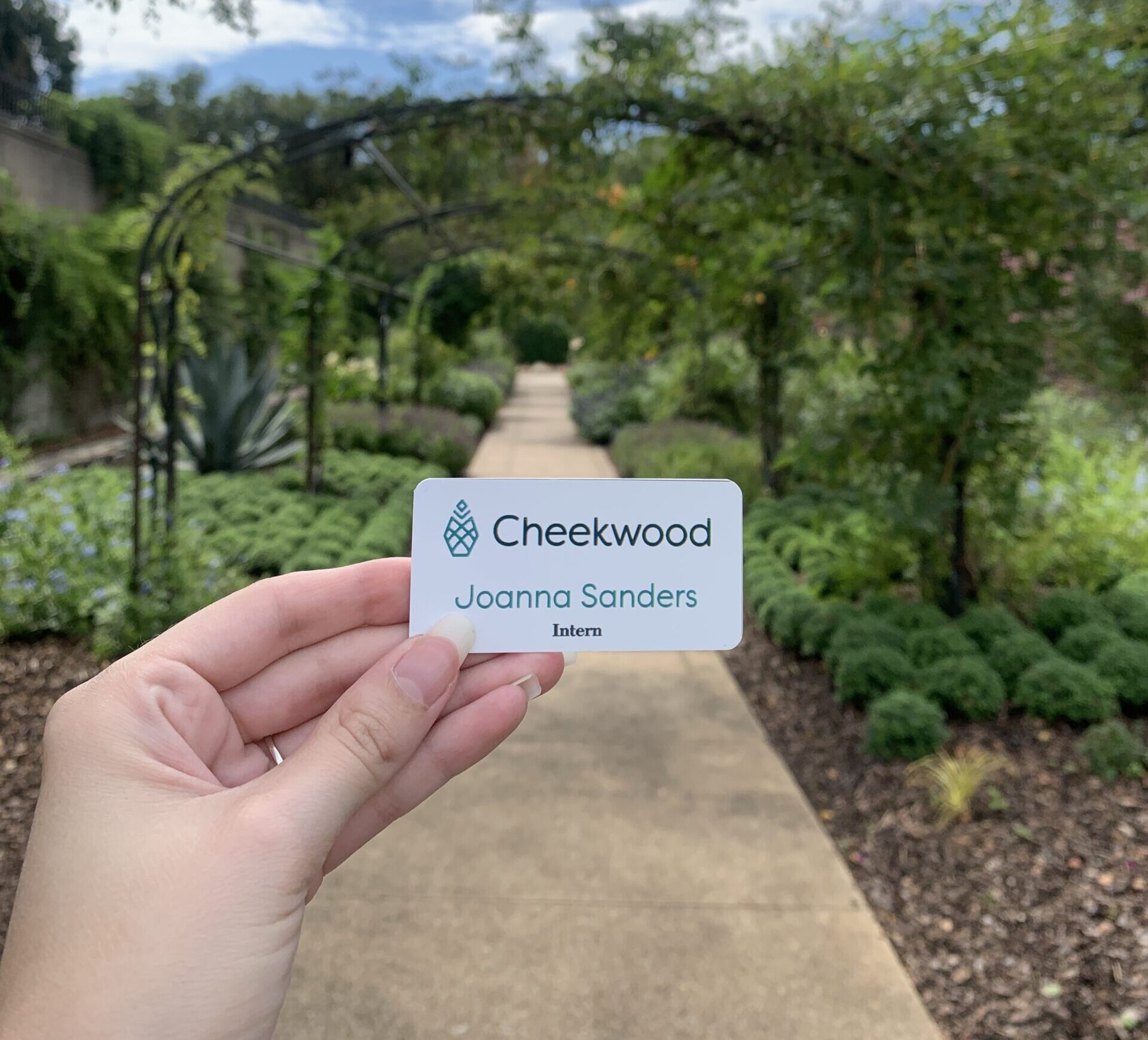
Photo 3_Joanna Name Tag

Digital Marketing Intern Joanna Sanders recaps her experience at Cheekwood.

Hello! I’m Joanna Sanders, and I had the wonderful opportunity to be Cheekwood’s Digital Communications Intern this summer. As a recent graduate with a degree in Journalism and a minor in Interactive Media from Middle Tennessee State University, I’ve built a diverse skill set in journalism, social media, and public relations. My journey has included meaningful work with local nonprofits like Corner to Corner and Craft Content Nashville, as well as a role as a Junior Publicist Intern at Music City Media on Music Row. One of my proudest achievements was seeing my story about Vietnam War veterans who are also renowned artists featured on the cover of The Daily News Journal. All these experiences have led me to Cheekwood, and I’m deeply grateful to contribute here.

Why did you want to be a Cheekwood intern?

As a Nashville native, Cheekwood has always held a special place in my heart. When I discovered this internship, it perfectly aligned with my career goals and passion for working with a beloved local nonprofit. Applying was a no-brainer, and I’m thrilled I did. This internship has not only enhanced my multimedia skills but also deepened my appreciation for nature, art, and the dedicated people who preserve them.


What is my favorite garden?

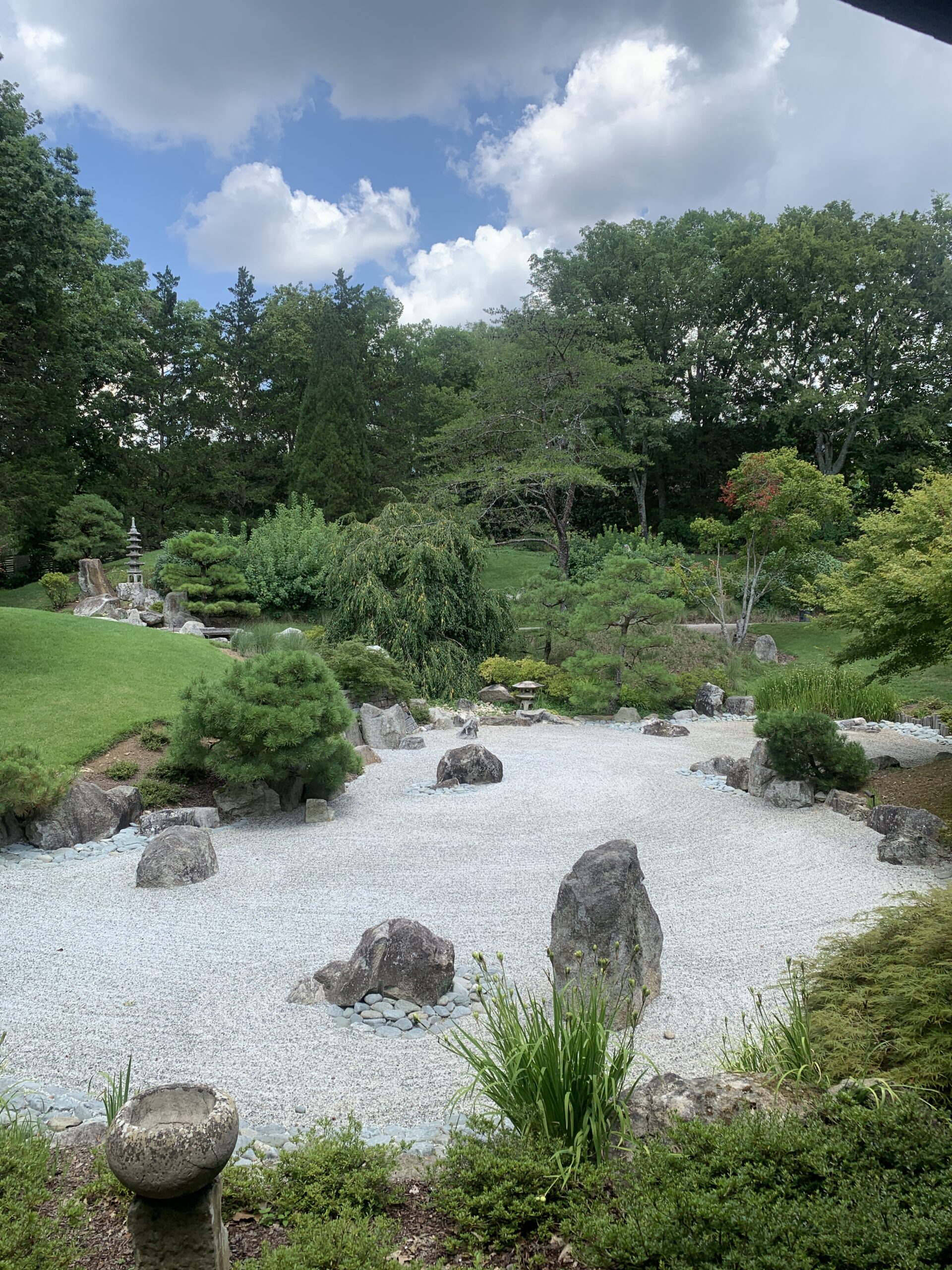
My favorite garden is the Blevins Japanese Garden. From the viewing pavilion, it reveals a breathtaking panorama unlike any other I’ve experienced. The bamboo trail and the soothing water fountain cultivate a unique atmosphere of tranquility. With a bit of luck, you might spot wildlife, including deer with their fawns or playful chipmunks roaming through the serene landscape.

What does an average day at Cheekwood look like?

At Cheekwood, every day brings a new adventure, which keeps things exciting! My routine includes exploring the gardens and Mansion to capture stories and footage, assisting with photo shoots, and photographing new items or sales in the Garden Shop and Museum Shop. I cover events by taking photos and videos, posting live stories on social media, and editing and scheduling content. Additionally, I create Facebook events, research trends, analyze digital analytics, and compile monthly social media reports.

Photo 4_Japanese Garden
Photo 5_Joanna Working

Photo 2_Joanna Intro

What is your favorite part of working at Cheekwood?

I absolutely love working at Cheekwood, so choosing one favorite aspect is difficult. A standout moment for me was shadowing an artist interview during the installation of the new INTERVENTIONS art exhibition at the Mansion. Meeting the renowned British artist Ann Carrington, shaking her hand, and hearing her discuss her work in person was an unforgettable experience. Another highlight is working events like Thursday Night Out, Dog Nights of Summer, and the Under the Stars Concert Series. I was fortunate to be involved in every Dog Nights of Summer and Under the Stars concert, and I’ve seen firsthand the thought, effort, and energy that go into each event. As my time here comes to a close, I’m feeling bittersweet. The sentiment ‘Once you’re Cheekwood family, you’re always Cheekwood family,’ truly encapsulates what makes Cheekwood so special. Regardless of the role you play, big or small, you make a difference here. Thank you to everyone for your kindness and support throughout my journey at Cheekwood.


test

Top Plant Picks September 2024

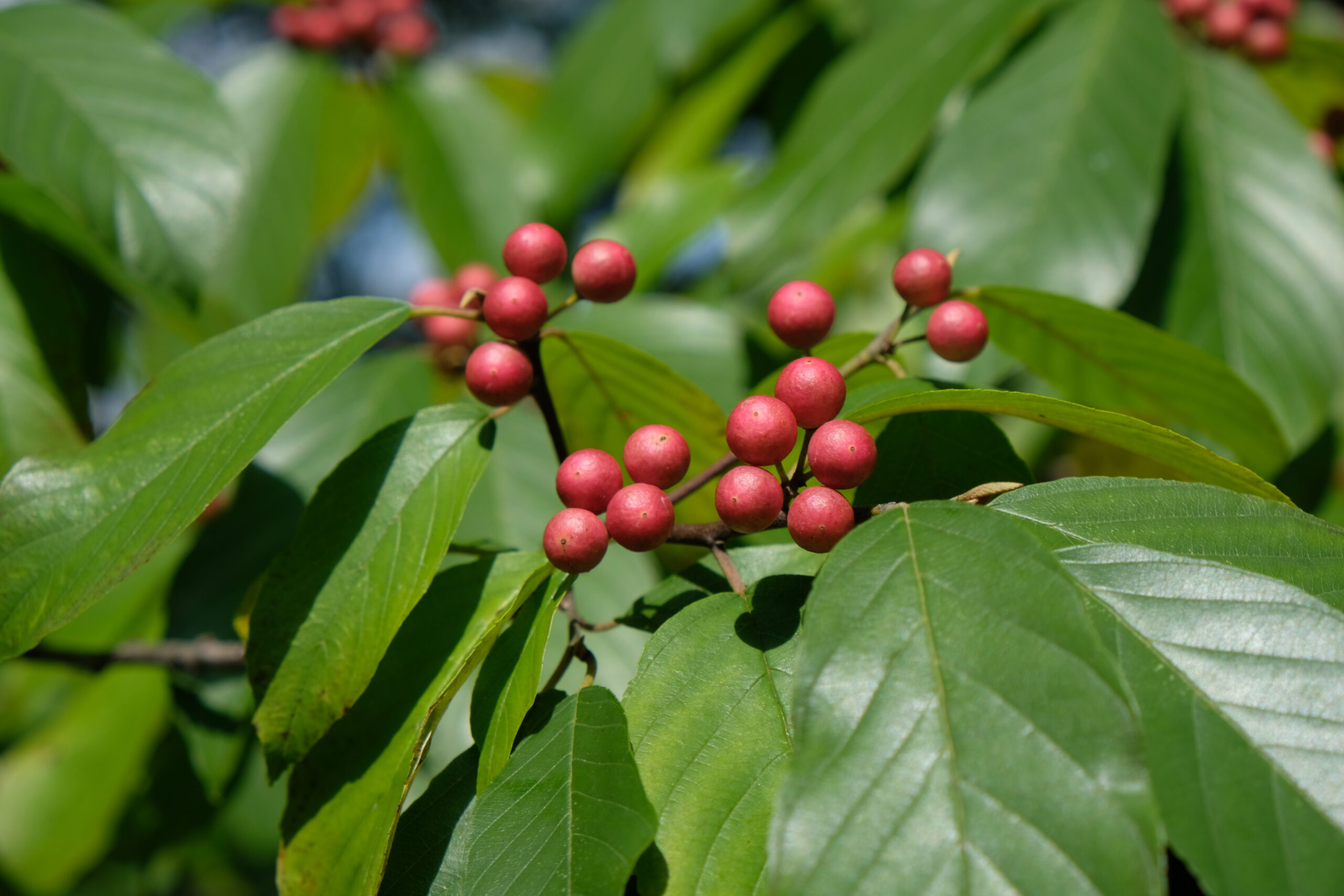
Rhamnus caroliniana (Carolina Buckthorn)

Bloom Time: May to June

Sun Requirement: Full Sun to Part Shade

Water Requirement: Medium

Wildlife: Fruit attracts birds

Tolerates: A variety of Soils

Native to North America: Yes

Zones: 5 to 9

Other: The flowers of this native shrub are followed by edible, showy red fruit that ripen to black in the fall.

Location: Herb Study Garden

Rhamnus caroliniana

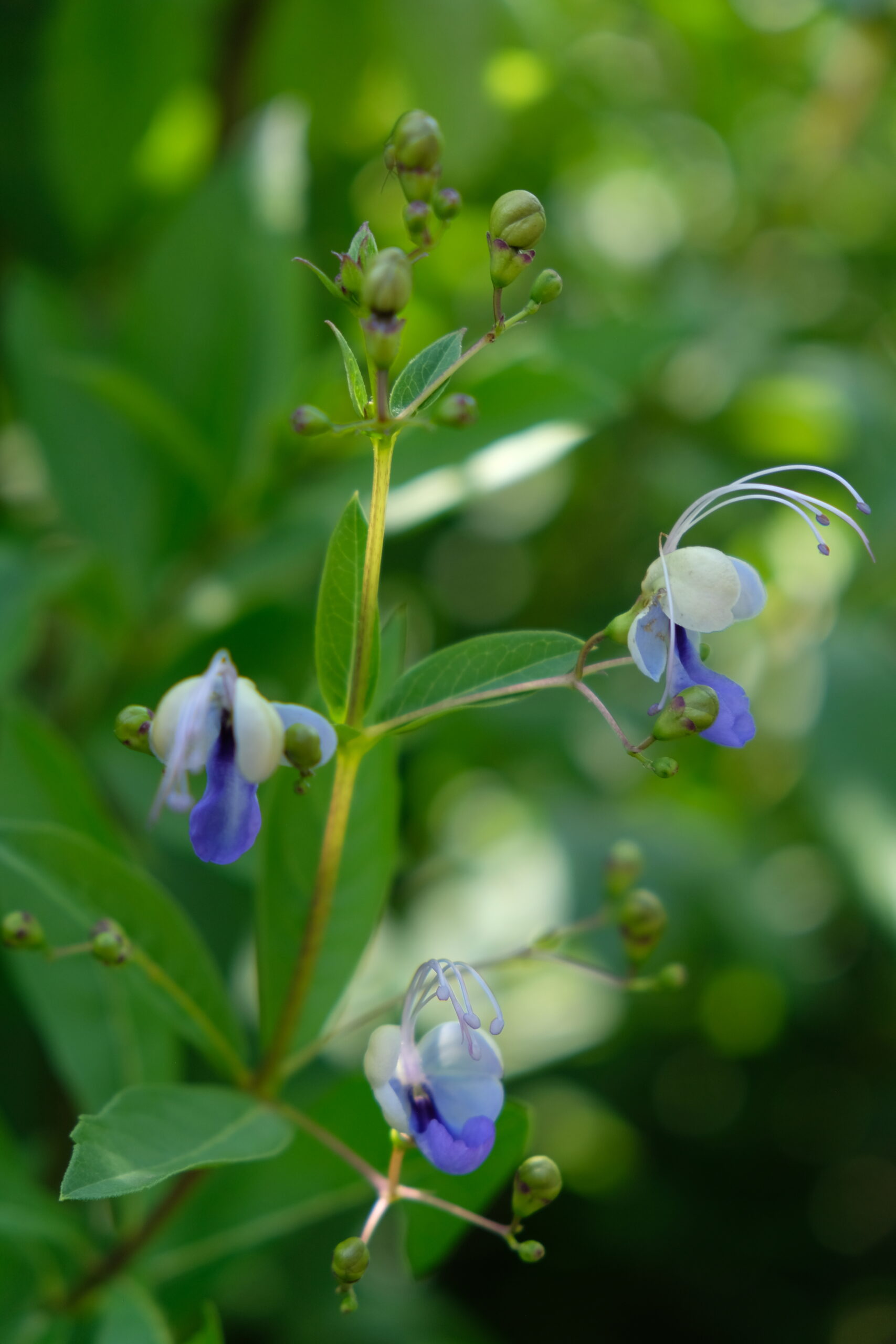
Clerodendrum ugandense (Butterfly Bush)

Bloom Time: June to September

Sun Requirement: Full Sun to Part Shade

Water Requirement: High

Wildlife: Bumblebees

Tolerates: Humidity

Native to North America: No

Zones: 9 to 11

Other: An annual in Tennessee, this plant has attractive violet-blue pea-like flowers.

Location: Color Garden

Clerodendrum ugandense

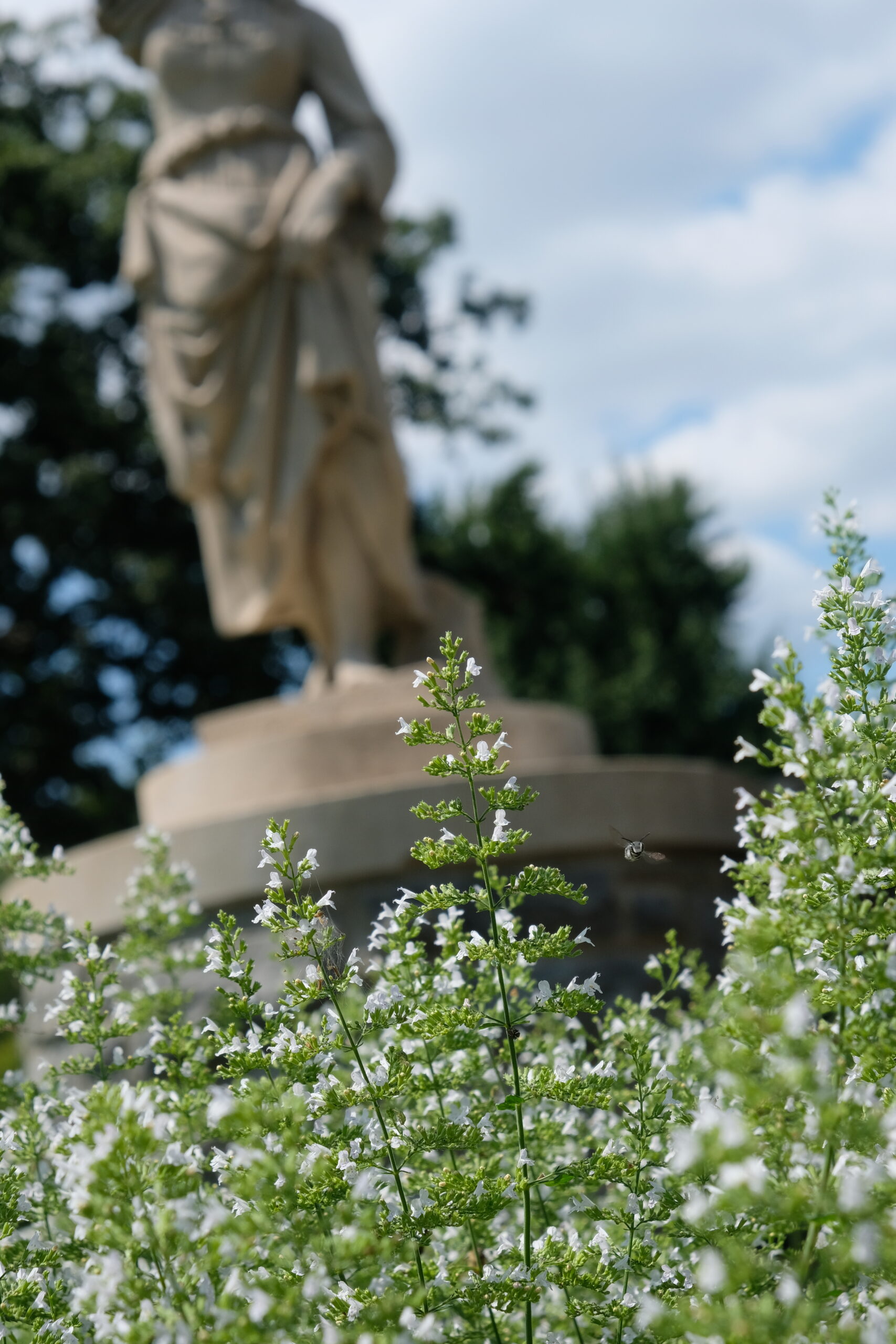
Calamintha nepeta ‘Montrose White’ (Calamint)

Bloom Time: June to October

Sun Requirement: Full Sun

Water Requirement: Low to Medium

Wildlife: Hummingbirds, honeybees, and Butterflies

Tolerates: Drought, Erosion, Shallow Rocky Soil

Native to North America: N/A

Zones: 5 to 9

Other: This perennial has airy white blooms all summer into the fall and wonderfully fragrant foliage.

Location: Petite Swan Garden

Calamintha nepeta 'Montrose White'

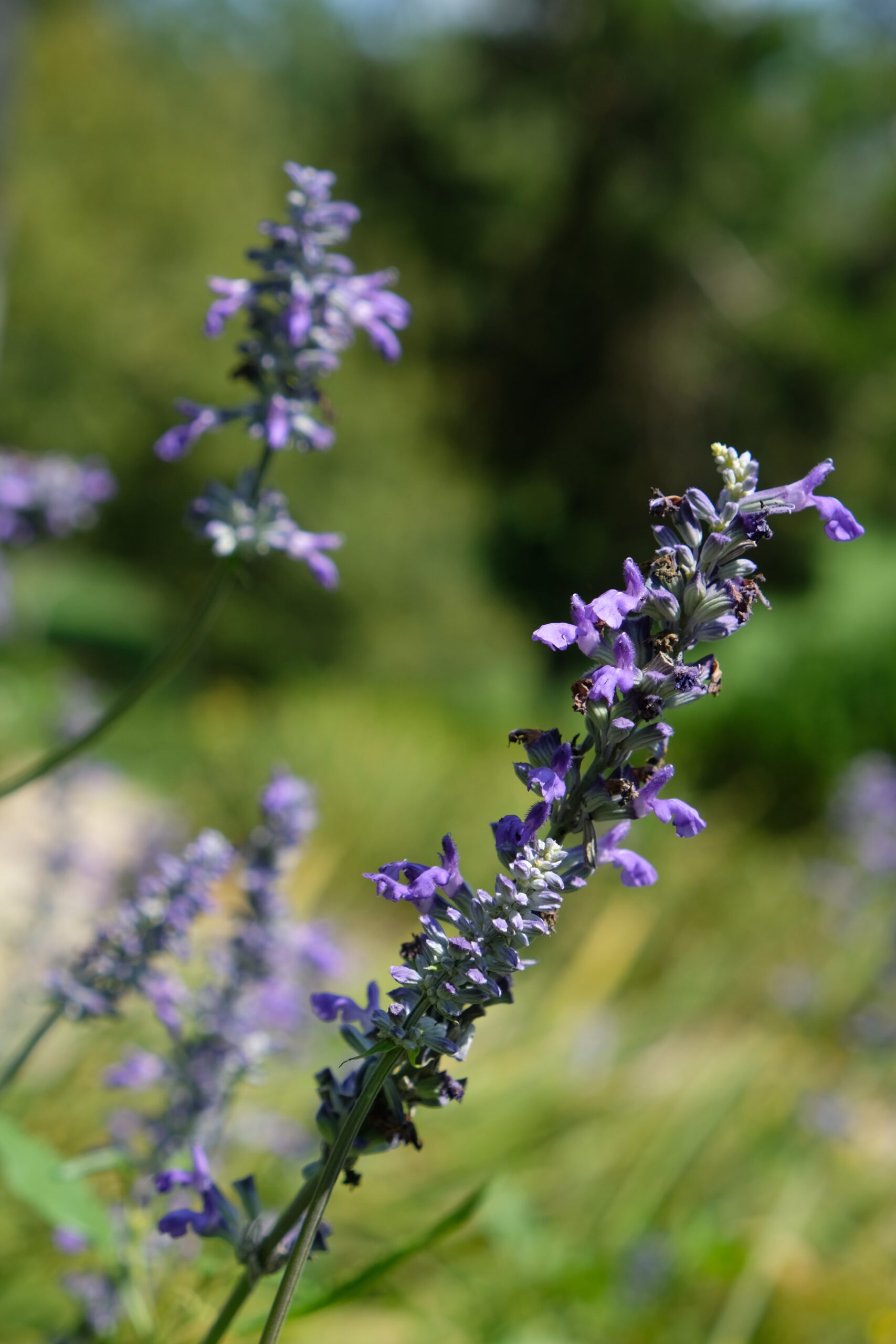
Salvia farinacea ‘Henry Duelberg’ (Mealy Blue Sage)

Bloom Time: June to October

Sun Requirement: Full Sun

Water Requirement: Medium

Wildlife: Attracts butterflies

Tolerates: Drought, Heat, and humidity

Native to North America: N/A

Zones: 7 to 10

Other: Showy spikes of fragrant blue flowers bloom all summer until frost.

Location: Sigourney Cheek Literary Garden

Salvia farinacea 'Henry Duelberg'

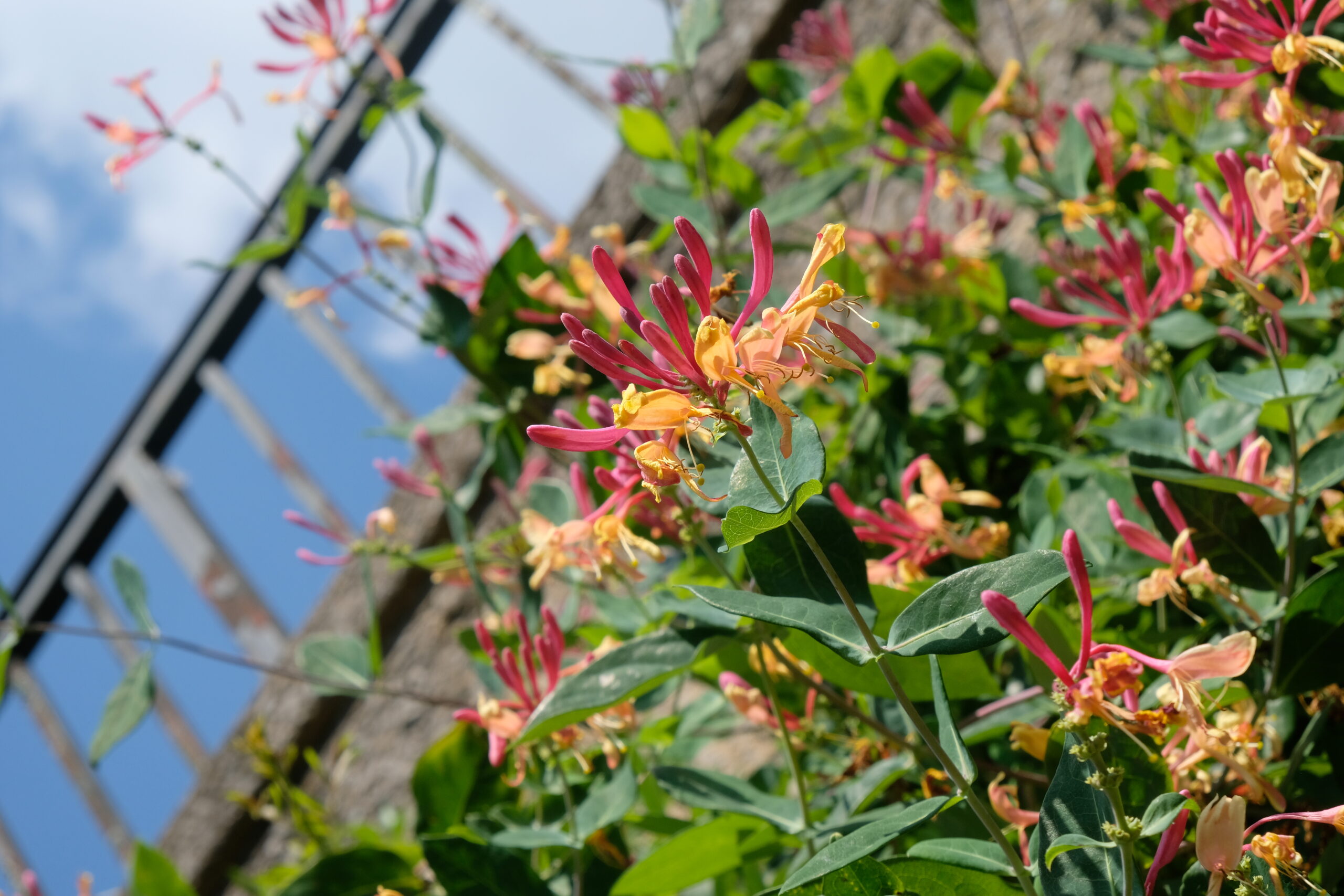
Lonicera × heckrottii ‘Gold Flame’ (Gold Flame Honeysuckle)

Bloom Time: May to October

Sun Requirement: Full Sun to Part Shade

Water Requirement: Medium

Wildlife: Bees, butterflies, moths, hummingbirds and songbirds

Tolerates: Black Walnut, Deer, Drought, Salt

Native to North America: N/A

Zones: 5 to 8

Other: A profusely flowering vine; the pink buds open to sweetly fragrant yellow orange blooms.

Location: Color Garden

lonicera x heckrottii 'Gold Flame'

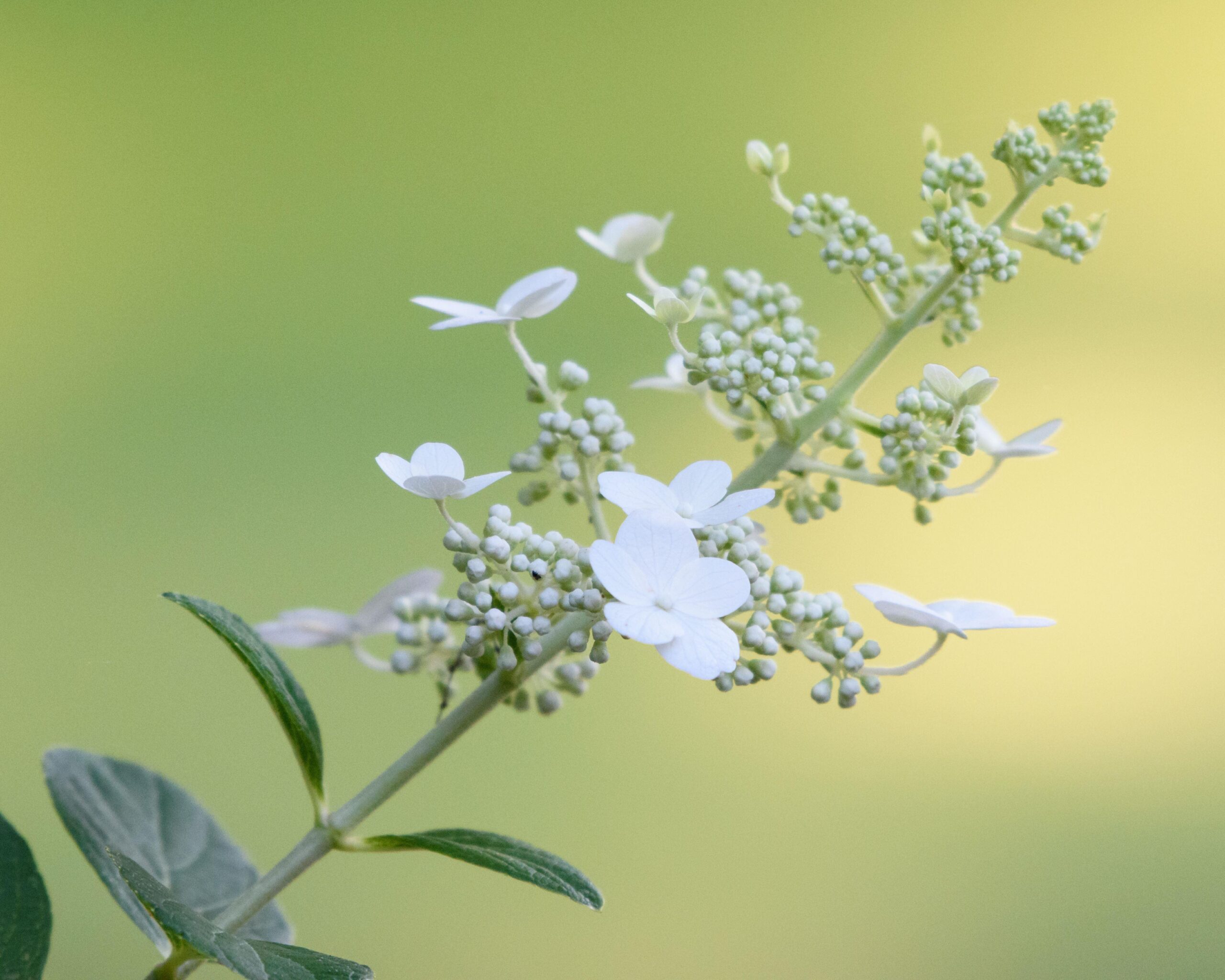
Hydrangea paniculata ‘Tardiva’ (Panicle Hydrangea)

Bloom Time: August to October

Sun Requirement: Full Sun to Part Shade

Water Requirement: Medium

Wildlife: Butterflies and bees

Tolerates: Salt

Native to North America: N/A

Zones: 3 to 8

Other: A deciduous shrub that grows up to 12 feet tall and features upright showy white flowers.

Location: Water Garden

hydrangea paniculata 'tardiva'

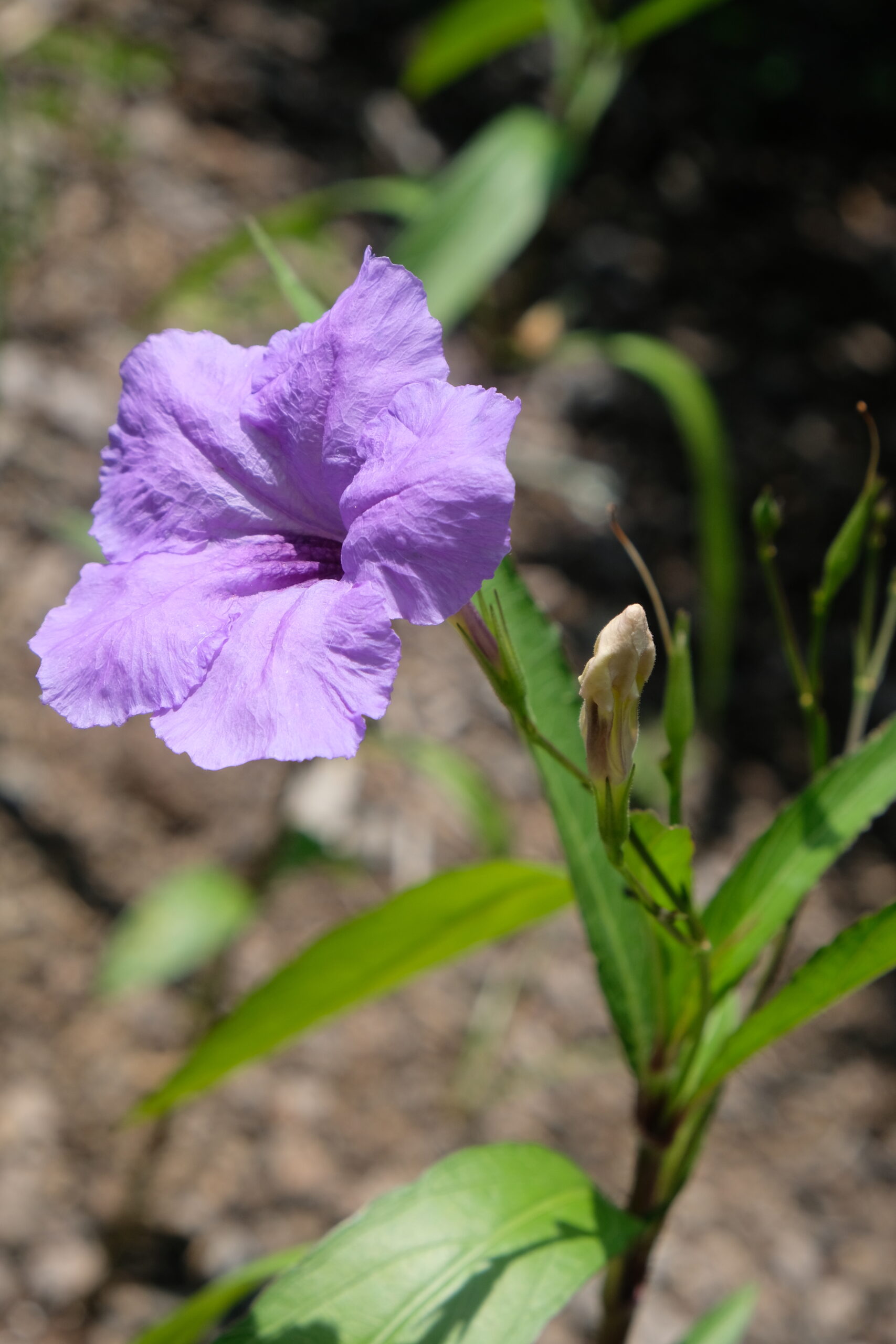
Ruellia ‘Mayan Purple’ (Mexican Petunia)

Bloom Time: May to October

Sun Requirement: Full Sun

Water Requirement: Medium

Wildlife: Butterflies, hummingbirds, and bees

Tolerates: Heat, humidity, Rabbit, Wet Soil

Native to North America: N/A

Zones: 8 to 11

Other: The purple flowers come in abundance and stand out nicely agains dark green leaves.

Location: Sigourney Cheek Literary Garden

Ruellia 'Mayan Purple'

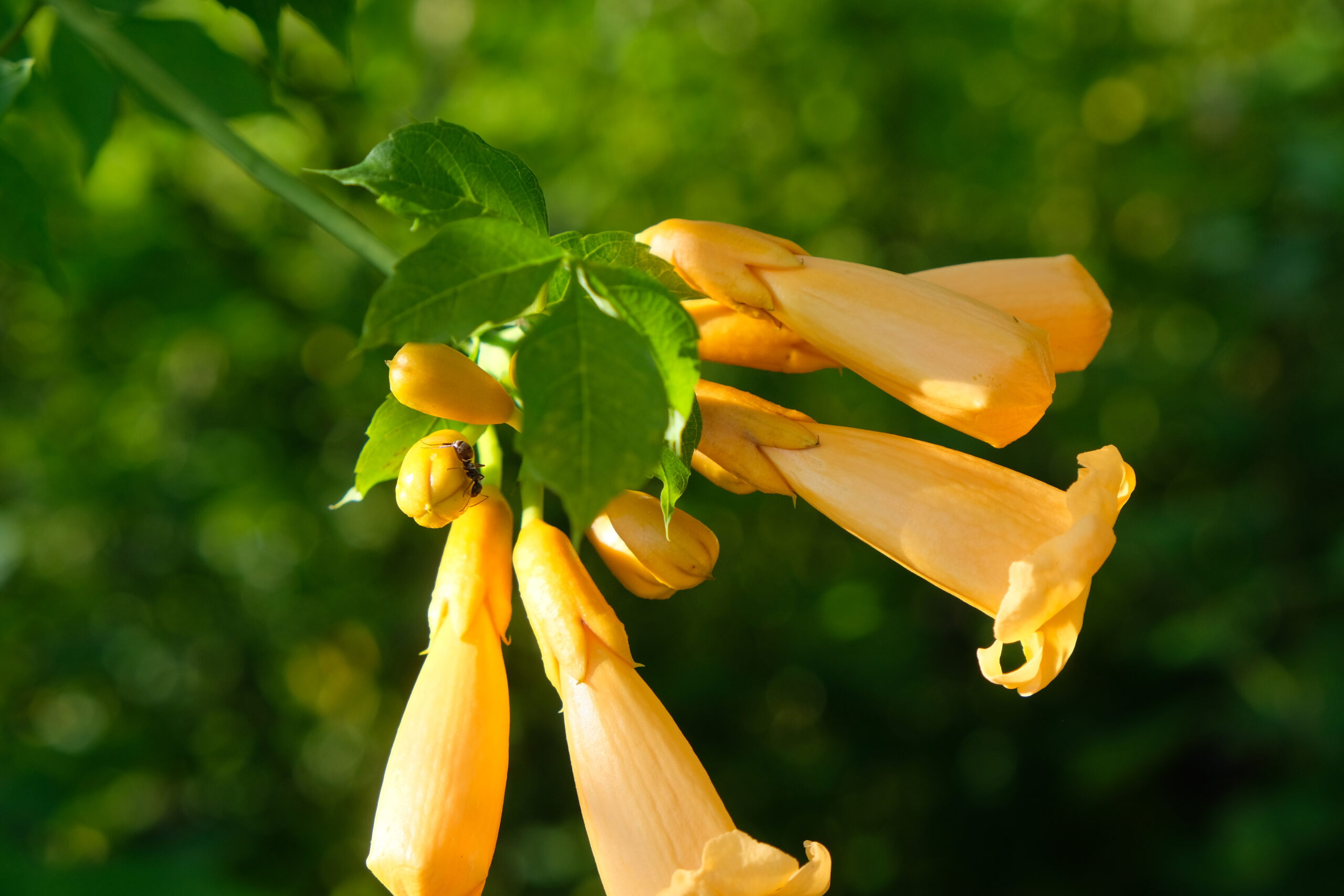
Campsis radicans f. flava (Trumpetcreeper)

Bloom Time: July to September

Sun Requirement: Full Sun to Part Shade

Water Requirement: Medium

Wildlife: Hummingbirds and other pollinators

Tolerates: Deer, Drought, Clay Soil

Native to North America: Yes

Zones: 4 to 9

Other: Although this native vine has beautiful trumpet-shaped flowers, it can grow very aggessively.

Location: Color Garden

Campsis radicans 'Flava'

test

The Living Art of Bonsai

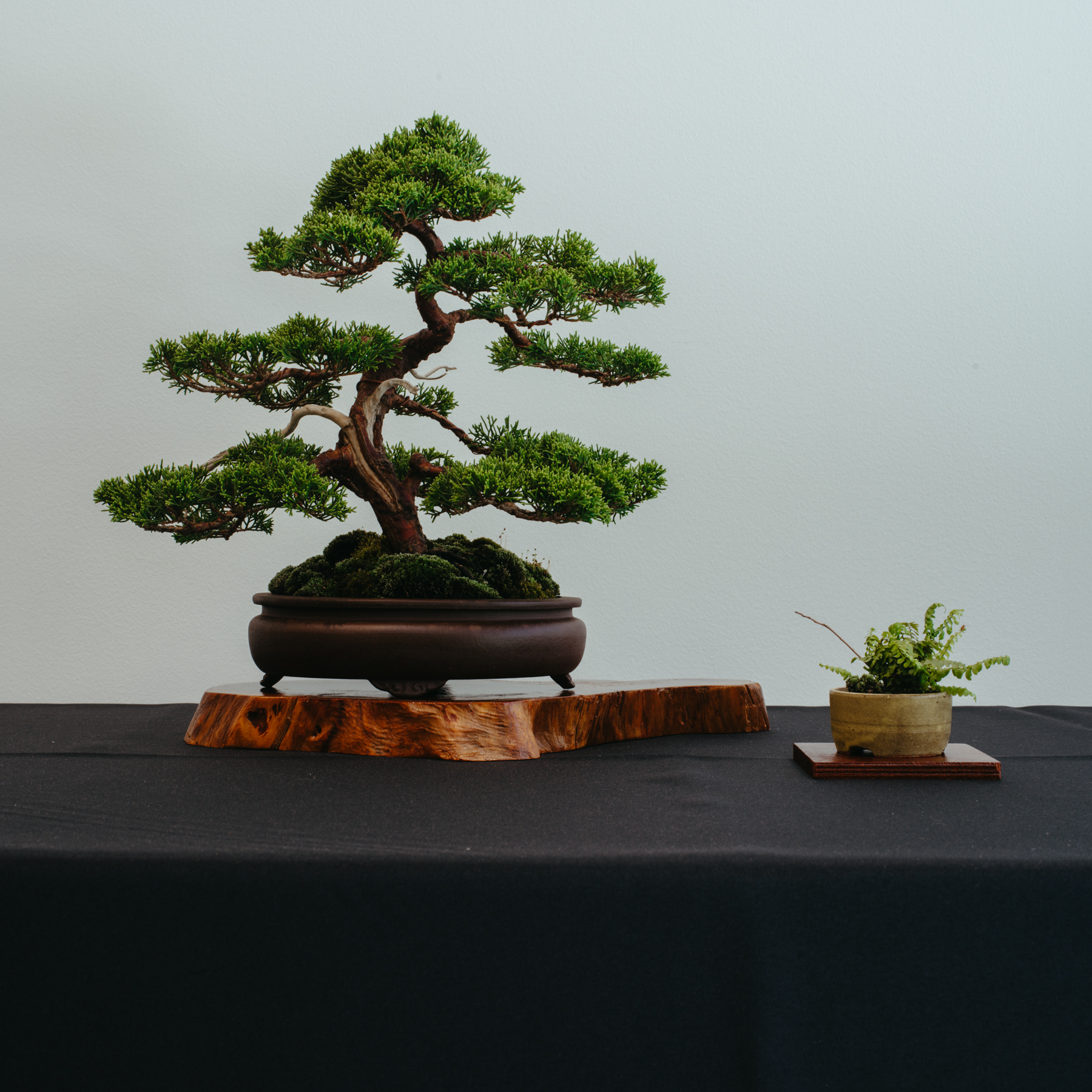
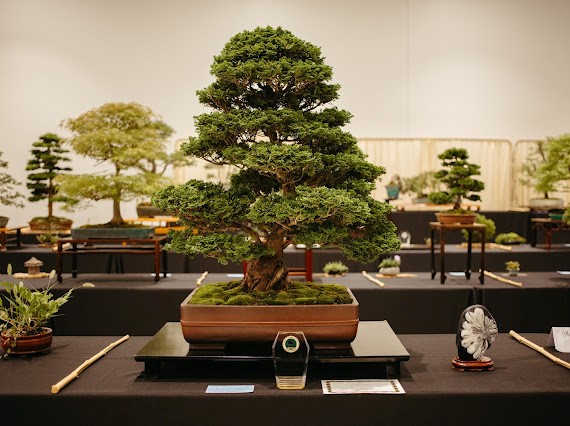
People’s Choice Award- Hinoki Cypress
People’s Choice Award – Hinoki Cypress. Photography by Bradley Spitzer
Featured Image above: Photography by Bradley Spitzer

Walking through a miniature magical living forest of meticulously manicured bonsai trees stops you in your tracks in a most fascinating way.

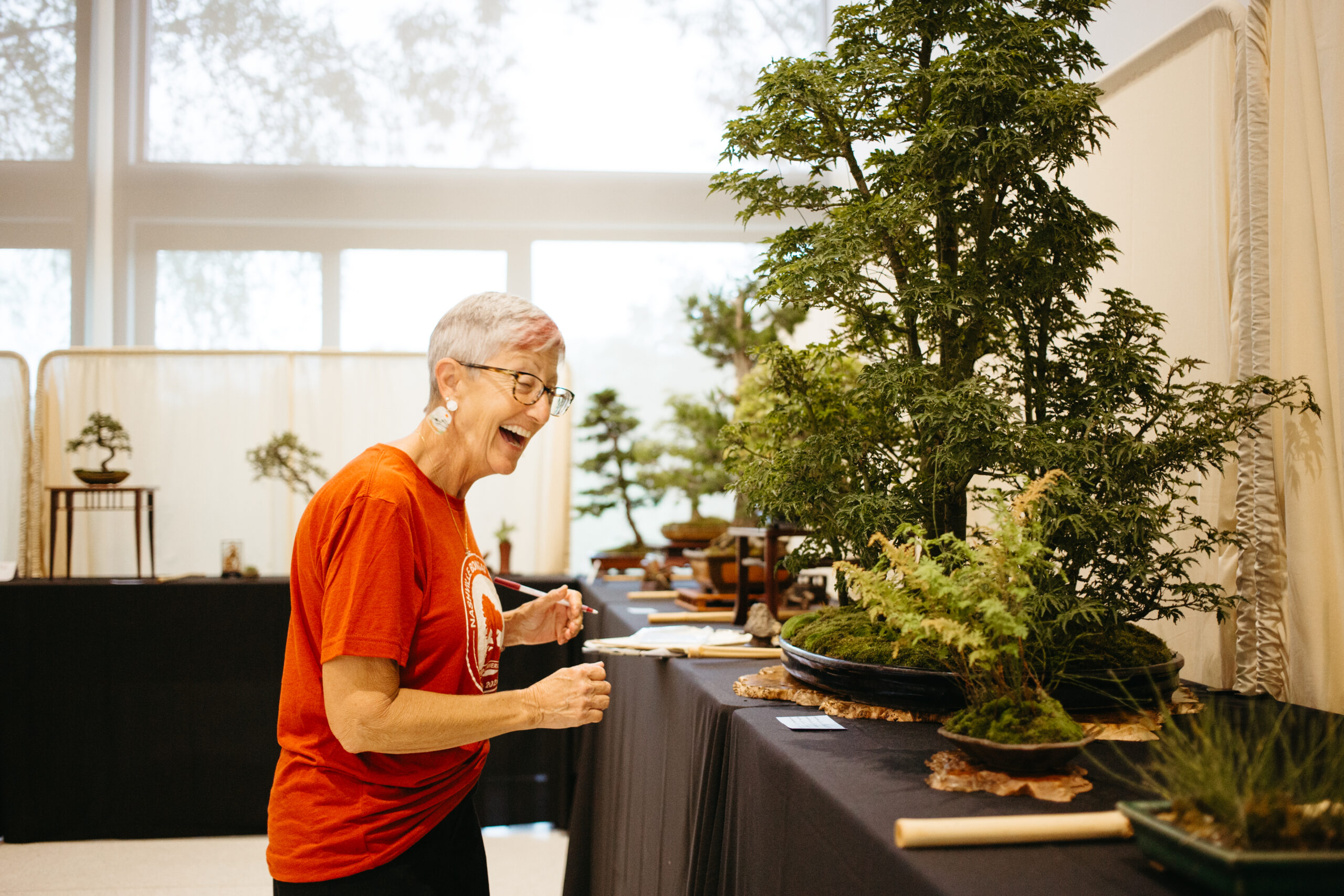
In July, Cheekwood’s Massey Hall was filled with more than 50 pristine potted dwarf plants – an intriguing sight, offering a diorama-like view of dynamic and exotic specimens, from deciduous to conifers and even tropical trees.

After an impactful first impression of so many beautiful bonsais in one place, it’s only natural to want to learn about and get a closer look into the fascinating world of bonsai.

The Nashville Bonsai Society (NBS) welcomes all levels of bonsai tree enthusiasts to their show, from novices to those who have passed trees through generations of family members over many decades. It’s an annual affair, but this was the NBS’ first time hosting a Statewide Bonsai Show, featuring 56 judged displays of bonsai specimens from Memphis, Nashville, Chattanooga, and Knoxville Bonsai Clubs. In addition to the stunning displays, there were live demonstrations, workshops, and vendors offering trees, stones, pots, and accents.


Bonsai history is rich, steeped in tradition and technique, and the practice is complex. There’s a lot to appreciate and learn. “Ultimately, it’s just really fun,” says Sara Hopson, President of the Nashville Bonsai Society.

“It’s like a representation of nature in miniature,” she says. “You’re actually trying to imitate nature, so the closer you can reflect in a small container what you see in nature, that’s kind of the whole essence of the art and everything that comes with it.”

In Japanese bonsai, the emphasis is on the tree. The viewing stones, accent plants, and other elements are all to enhance the tree – nothing is to take away from it. The passion that drives bonsai gardeners is not only enjoying the horticultural practice, but also having a genuine affinity for Japanese culture, history, innovation, and the community.

“We refer to ourselves as ‘treeple,’” Hopson says of the 130 active members in Nashville’s Bonsai club. In 2025, the gardening friends who make up Nashville Bonsai Society are celebrating 50 years since the club was founded in 1975.

Sara Hopson President 1
Sara Hopson, President of the Nashville Bonsai Society. Photography by Bradley Spitzer

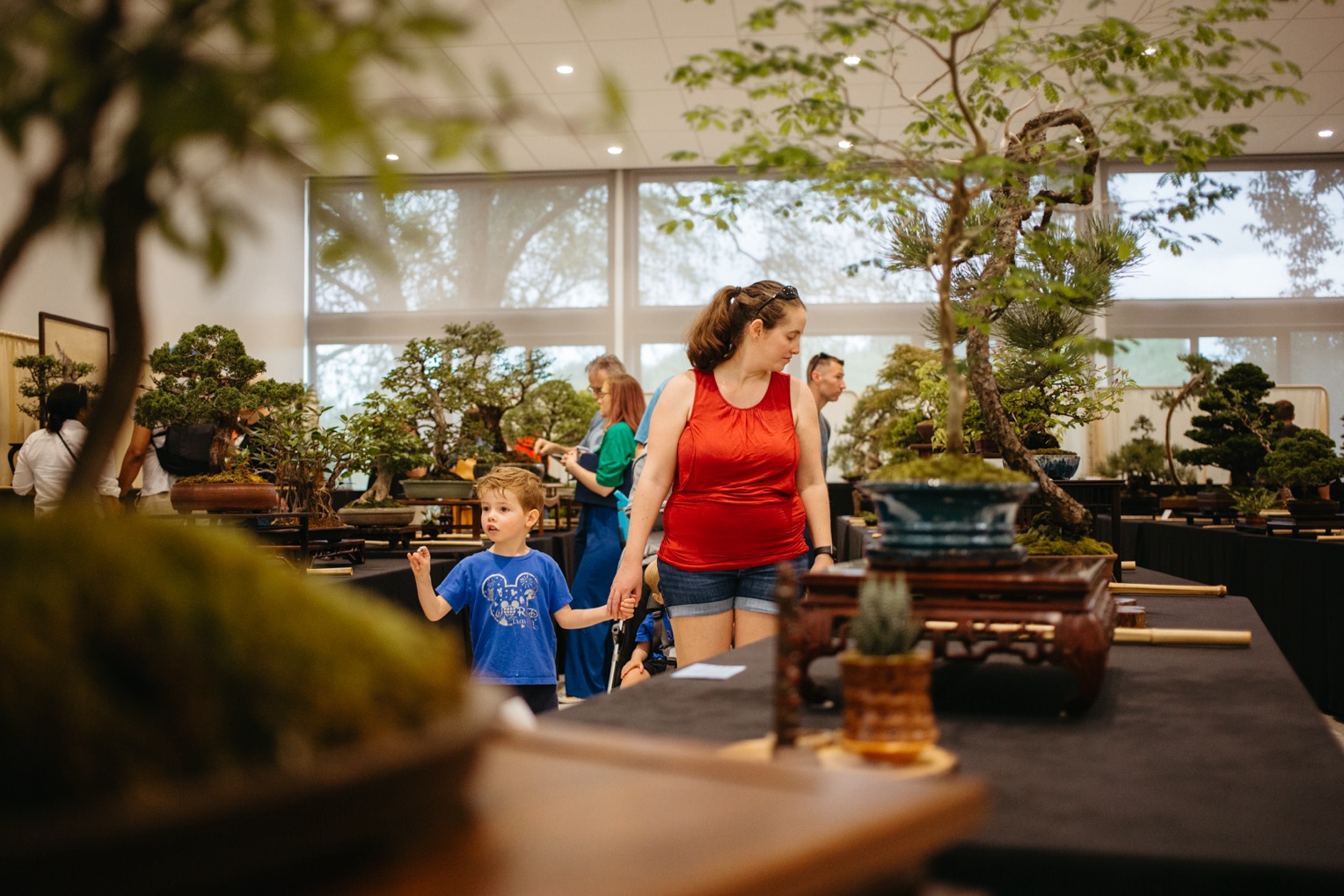
Bonsai Show Crowd 2
Photography by Bradley Spitzer

The term bonsai translates to dwarf trees in a container, using a tray-planting method for growing. The origins of bonsai technique date back thousands of years, anywhere from 4 to 700 BCE. Initially it developed as a native tradition integral to the Chinese Empire. The Chinese practice penzai imitated entire landscape scenes in nature in a controlled environment. The tradition later reached Japan through war times, and Japan embraced the art of bonsai and innovated it to incredible levels, with a focus on the tree. The technique was introduced to the West much later, in the 1940s after World War II.

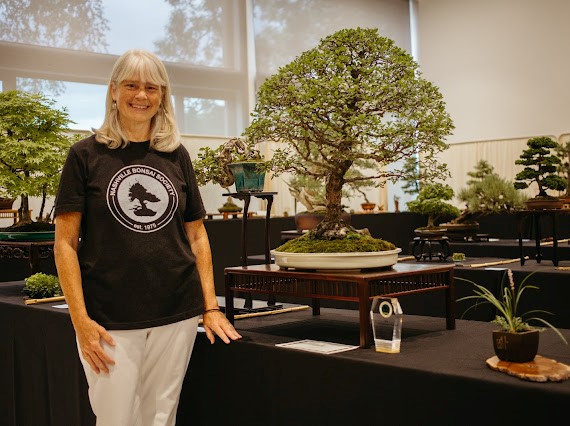
Japanese horticulture is generational, with family elders passing trees and knowledge to younger members. It’s part of daily life. The local Nashville club embodies these traditions. Hopson first took up the hobby with her adult son in 2017 as a refreshing way to spend time together. Club member Carolyn Evans, whose father was a founding member of the Nashville Bonsai Society, inherited his extensive collection and presides over the care of his trees as well as her own. At this year’s show, Evans won the “Best Deciduous” award for her Chinese Elm.


Best Deciduous Award, Chinese Elm with Carol Evans.
Best Deciduous Award, Chinese Elm with Carol Evans
Photography by Bradley Spitzer
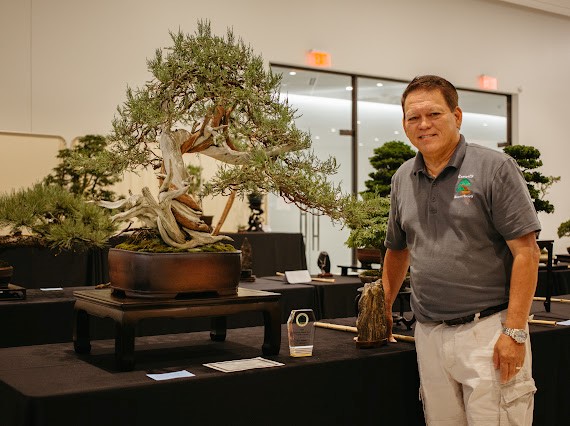
Best Display Award, Rocky Mountain Juniper with Dat Tran
Photography by Bradley Spitzer

A tree in a pot may sound simple, but the work put into maintaining a bonsai is not. Keeping bonsai trees alive and thriving takes extensive dedication, cultivation, and a certain level of horticultural knowledge of bonsai shaping, aesthetics, pruning, wiring, and repotting. An interesting fact to keep in mind: Bonsais are not genetically dwarfed, so any tree species can be used.

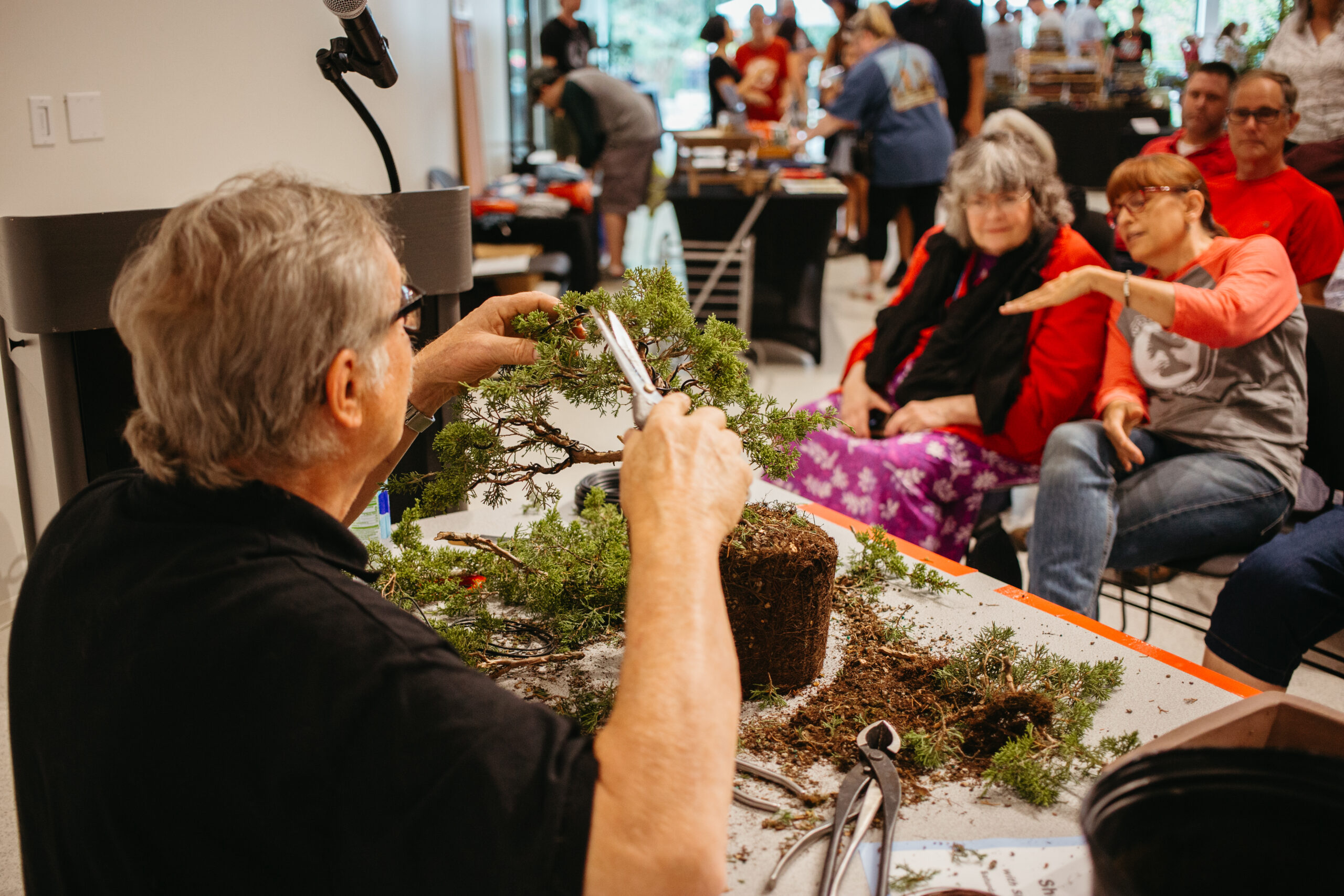
At Cheekwood’s 2024 Bonsai show, judge Brussel Martin of Brussel’s Bonsai Nursery in Olive Branch, Mississippi, gave a pruning demonstration and shared some fundamental tips for the bonsai-in-training. For those who are looking to pursue this hobby, Brussel’s four basic guidelines are charmingly accessible.

Brussel Martin’s Bonsai Proverbs:

  • “Cut the tips, that’s where you create energy.”
  • “It’s hard to overwater, err on the side of more.”
  • “Morning light, afternoon shade.”
  • “Straight tree, short life. Crooked tree, long life.”

Brussel Martin Bonsai Demo 1
Brussel Martin gives a bonsai demonstration.
Photography by Bradley Spitzer

Of course, this is only the beginning. There is endless knowledge to glean in the craft of bonsai, and the only bounds are your own imagination.

On September 15, the Nashville Bonsai Society comes together again at Cheekwood for the annual Japanese Moon Viewing Festival, Otsukimi.

Set in Cheekwood’s gardens, the special event celebrates Japanese culture, art, and horticulture. The Nashville Bonsai club displays trees at the event, gives pruning demonstrations, offers beginner bonsai workshops, and hosts kids’ activities. “We love giving back to the community,” Hopson says. “It’s such an inclusive day with so many activities going on. It is an outstanding event.”

At last year’s Japanese Moon Viewing, Nashville’s Consul-General of Japan, Shinji Watanabe, personally thanked the Nashville Bonsai Society for bringing an authentic touch to Otsukumi at Cheekwood.

“That was really a special moment for me,” Hopson says.

Next month, Nashvillians can experience the living art of bonsai in a one-of-a-kind setting under the Harvest Moon.

test

Volunteer Spotlight: Alison Wilms


Alison supports Cheekwood in so many different ways. She loves to try different volunteer assignments, always with curiosity, embracing the opportunity to learn something new. Serving at cultural and seasonal events, concerts, children’s activities, education programs, art exhibitions, conservation and gardening projects, along with community outreach, she finds joy in taking advantage of a myriad of volunteer opportunities that Cheekwood has to offer. Alison is a true ambassador for Cheekwood, her enthusiasm creates excitement, and her cheerful welcome enhances every encounter. She is a champion of promoting the volunteer experience and embodies what it means to serve.


Tell us a little about yourself and your background.

I grew up and went to college in Ohio for social work. I started out my career there and then traveled to different countries doing some volunteer and mission work. After coming back to the States, I’ve lived in Ohio and Florida prior to moving to Nashville. I moved here almost 5 years ago and have loved discovering Cheekwood and all Nashville has to offer.

What are your favorite hobbies, activities, or interests?

I enjoy hiking, traveling, and volunteering/being involved in my community; as well as, being out in nature and reading a good book. And of course, spending time with family and friends.

What is your favorite garden or area at Cheekwood and why?

The Robinson Family Water Garden. I love being by the water and there are benches or tables to be able to sit and read or journal or chat with others or just to be still. You can also still see the beauty of some of the surrounding areas.

Do you have a favorite artwork at Cheekwood, or, if not, a favorite exhibition that Cheekwood has hosted? Is there a reason you like it?

I’ve enjoyed the outdoor exhibits like Bruce Munroe and the new troll exhibit. And inside the mansion, I really loved the exhibit from Sarah Nguyen.

In what ways have you been involved as a volunteer with Cheekwood so far?

I’ve helped out in various ways over the past year or so. I’ve helped with the different events as a greeter or in the children’s activities. With the Holiday Lights, I helped put together the s’more boxes, was a door greeter to the mansion, a Santa line guide, and also helped with the gift shop.  I’ve also helped with the “Weed Wrangle” in the Spring and helped at the Cheekwood booth at different outreach events.

Why did you decide to become a volunteer?

I volunteered with Cheekwood starting a little over a year ago through Hands on Nashville. I work from home and was looking for ways to get out into the community. I enjoyed being there the day I volunteered and another volunteer talked about signing up to volunteer with Cheekwood directly so I decided to do so that day!

What have you enjoyed the most about your volunteer experience?

Being able to enjoy Cheekwood, all while getting to interact with others. And getting to know the other volunteers and staff.

Is there a funny or inspirational story you can briefly tell about your volunteer experience?

It’s great seeing all the cultural events and how Cheekwood is for everyone. Helping with some of the kids activities, you can see the care Cheekwood staff puts into planning as it isn’t just for fun but also educational. It’s been fun to be a part of and see adults wanting to take part as well.

Do you have any advice for individuals considering volunteering with Cheekwood?

Do it. Even if through Hands on Nashville to see if you like it and want to get involved more. Talk with Amy (the volunteer coordinator) or any of us volunteers – we’d be happy to answer any of your questions.

For more information about volunteering visit our volunteer web page: www.cheekwood.org/support/volunteer

test

Member Spotlight: Marilyn Switzer

<h2>I love the Carell Trail, the Bracken Foundation Children’s Garden, <br>the Wisteria Arbor…I just love all of Cheekwood.</h2>
Marilyn Switzer | Cheekwood member since 1998

Marilyn Switzer has membership memories spanning more than 25 years and she’s looking forward to making more. A proud native Nashvillian, Marilyn loves reading, photography, spending time with her grandchildren, most any kind of arts and crafts, and enjoying time with friends. We recently had the opportunity to chat with Marilyn. Read on as she shares some cherished Cheekwood experiences.


What inspired you to become a Cheekwood member?

I love the history and the beauty [of Cheekwood] and wanted to be able to enjoy it whenever I could.

What is your favorite time of year at Cheekwood?

That is so hard to say, but probably the fall, which is pretty much my favorite time of year.

Which gardens, areas, or plants do you most enjoy when visiting Cheekwood, and why?

I love the Carell Trail, the Bracken Foundation Children’s Garden, the Wisteria Arbor … I just love all of Cheekwood. I love taking pictures there.

2024 Member Spotlight_MSwitzer_photo8
2024 Member Spotlight_MSwitzer_photo4

Do you have a favorite piece of art at Cheekwood or a favorite art exhibition Cheekwood has hosted?

The Chihuly exhibitions have by far been my favorites. I enjoy them all, but having taken one workshop in glassblowing, I am amazed at the glass arts.

What is one of your favorite memories involving Cheekwood?

I took my daughter and her husband one evening during the first Chihuly exhibition. We went in the evening, had a picnic dinner, and just enjoyed everything about the night. The weather was perfect.

Why do you think Cheekwood is important – for individuals, families, and communities?

The history of the grounds and the home is part of Nashville’s history, so being aware of the philanthropy of the Cheek and Sharp families is of value and could be an inspiration for personal giving. Many of the exhibitions that are there may not be available to many except for Cheekwood’s planning and offering. The importance of the artistic and creative processes cannot be overstated.

2024 Member Spotlight_MSwitzer_photo7
2024 Member Spotlight_MSwitzer_photo3

Cheekwood offers so many programs and activities that our members really enjoy. What are some that you or your family have especially enjoyed?

My grandchildren and I take advantage of many of the activities throughout the year. The TOTS program that now is most every day, the TRAINS … just everywhere you look at Cheekwood, there is something to do and enjoy. One grandson attended summer camp there for two or three years and loved it. Plus, we’re coming to see the TROLLS.

How would you encourage others to become Cheekwood members?

I tell any and everybody that my membership at Cheekwood is most likely the best money I spend in a year. I live fairly close and can run over there to hike the sculpture trail, take pictures, see special exhibitions, and just enjoy the beauty.

Join Cheekwood today and experience the unrivaled beauty of Nashville’s Country Place Era Estate. Members can enjoy inspiring art and garden exhibitions, family activities, programming for all ages, music events, and year-round seasonal festivals.

test

Top Plant Picks August 2024

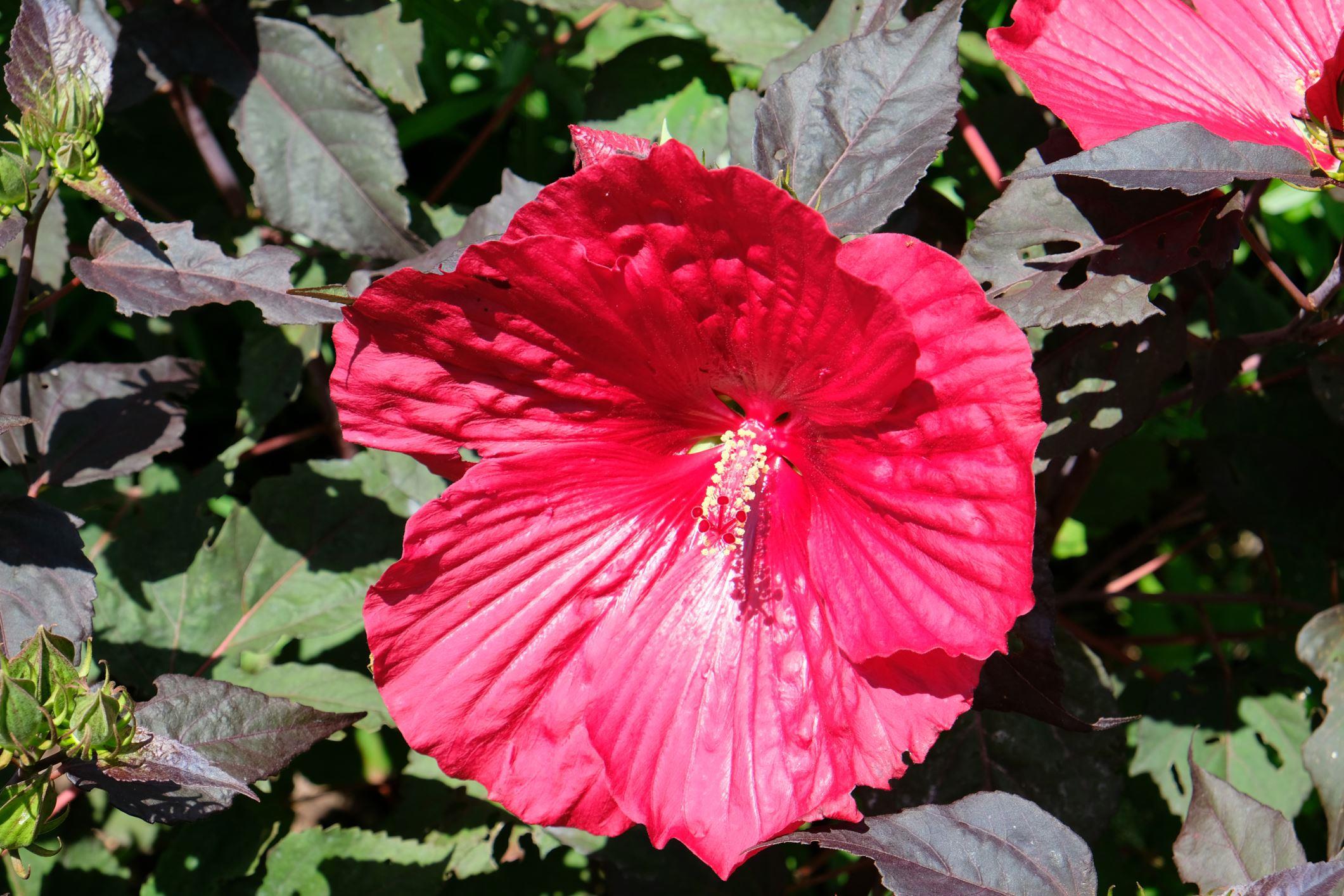
Hibiscus × ‘Holy Grail’ (Rose Mallow)

Bloom Time: July to August

Sun Requirement: Full Sun to Part Sun

Water Requirement: Medium

Wildlife: Attracts Hummingbirds and bees

Tolerates: Drought tolerant but perorms best with consistent moisture

Native to North America: N/A

Zones: 4 to 9

Other: This hibiscus is a show-stopper with gorgeous dark, almost black foliage and deep red flowers.

Location: Wills Perennial Garden

O

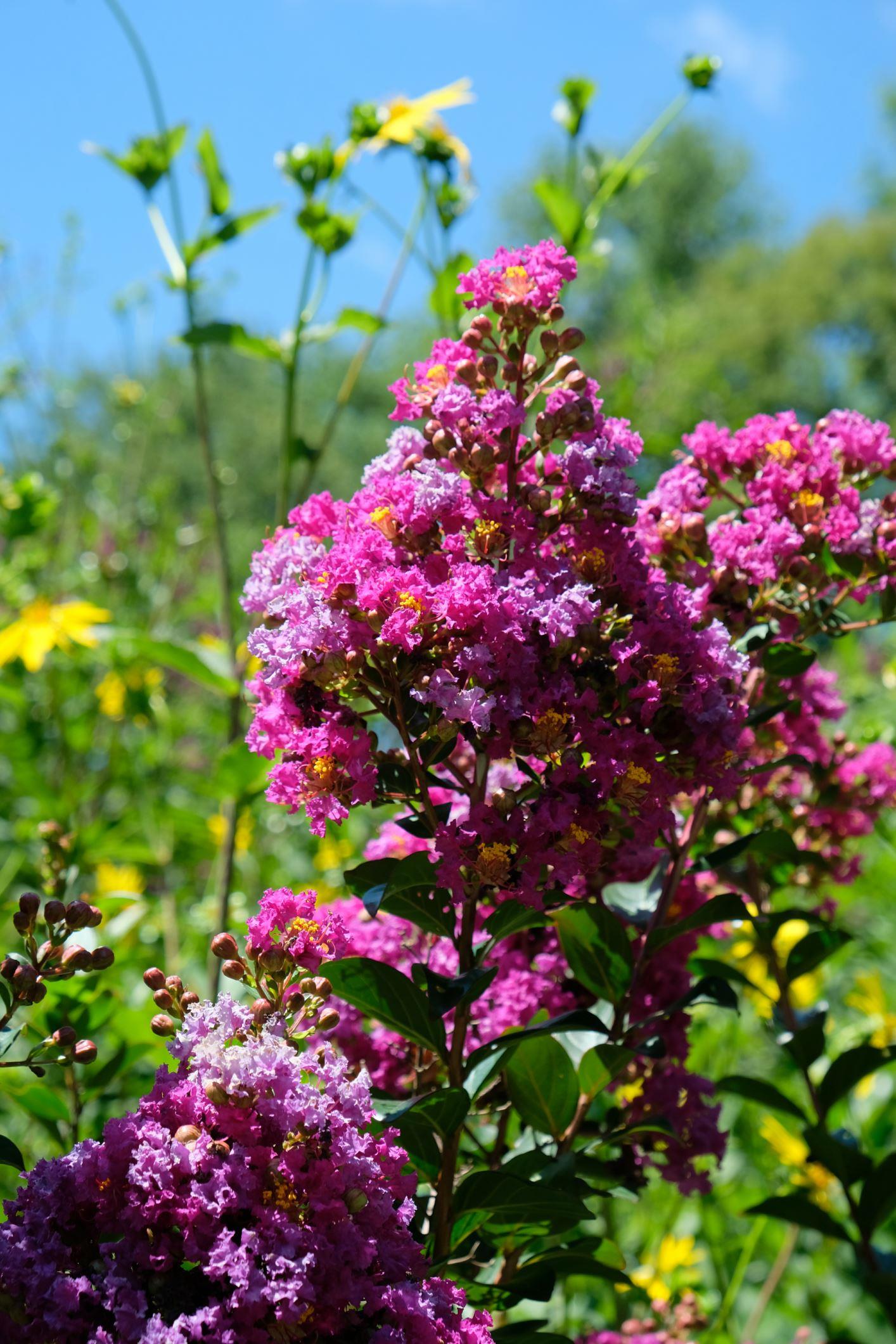
Lagerstroemia ‘Catawba’ (Catawba Crape Myrtle)

Bloom Time: June to August

Sun Requirement: Full Sun

Water Requirement: Medium

Wildlife: Attracts honeybees and bumble bees

Tolerates: Mildew resistant

Native to North America: N/A

Zones: 7 to 9

Other: A small flowering tree reaching about 12 feet tall and features clusters of purple flowers.

Location: Bracken Foundation Children’s Garden

O

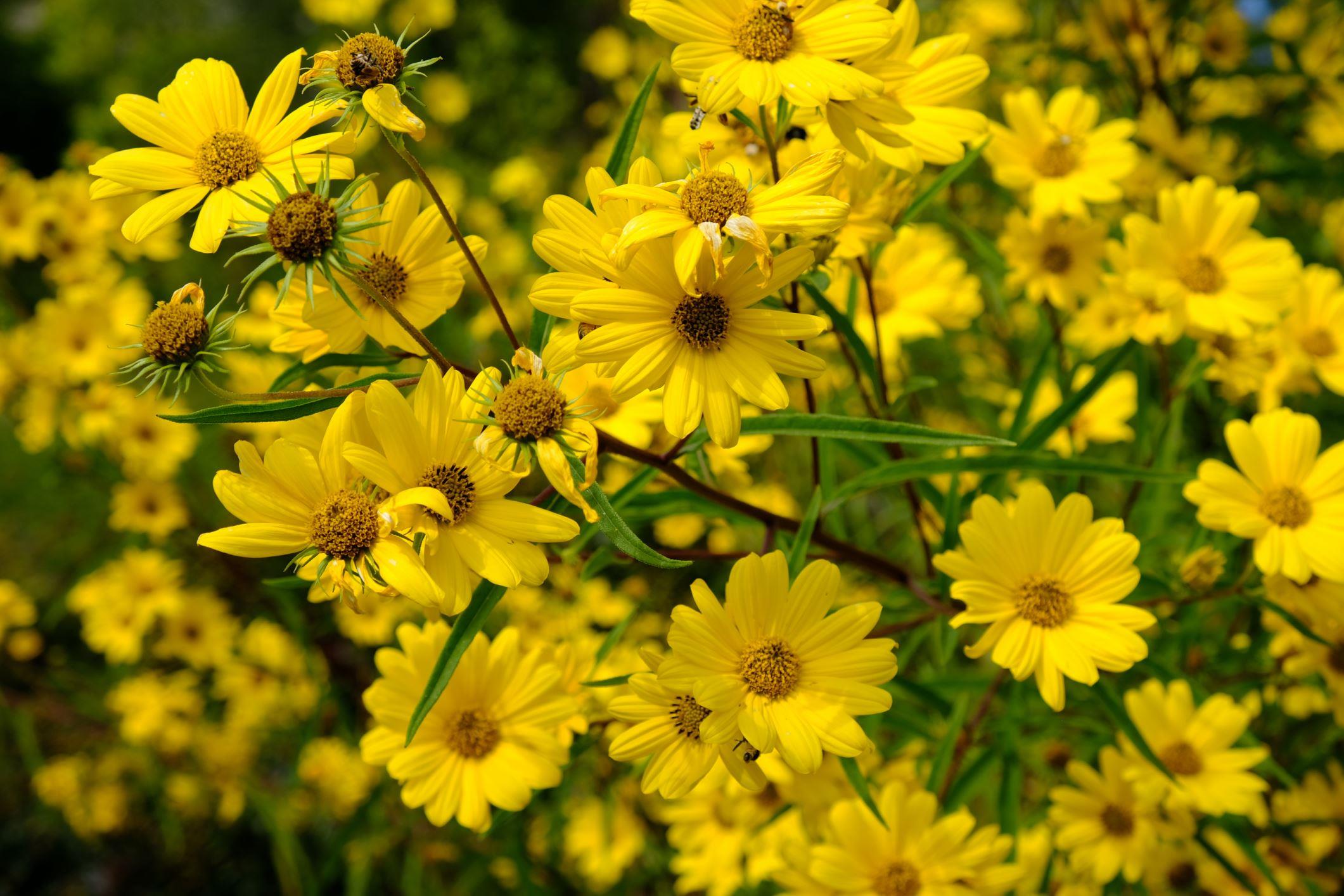
Helianthus giganteus (Giant Sunflower)

Bloom Time: August to November

Sun Requirement: Full Sun

Water Requirement: High

Wildlife: Seed heads attract birds, flowers attract bees and beetles

Tolerates: Wet soils

Native to North America: Yes

Zones: 2 to 8

Other: A very tall perennial with bright yellow daisy-like flowers that adds structure and height to garden beds.

Location: Wills Perennial Garden

O

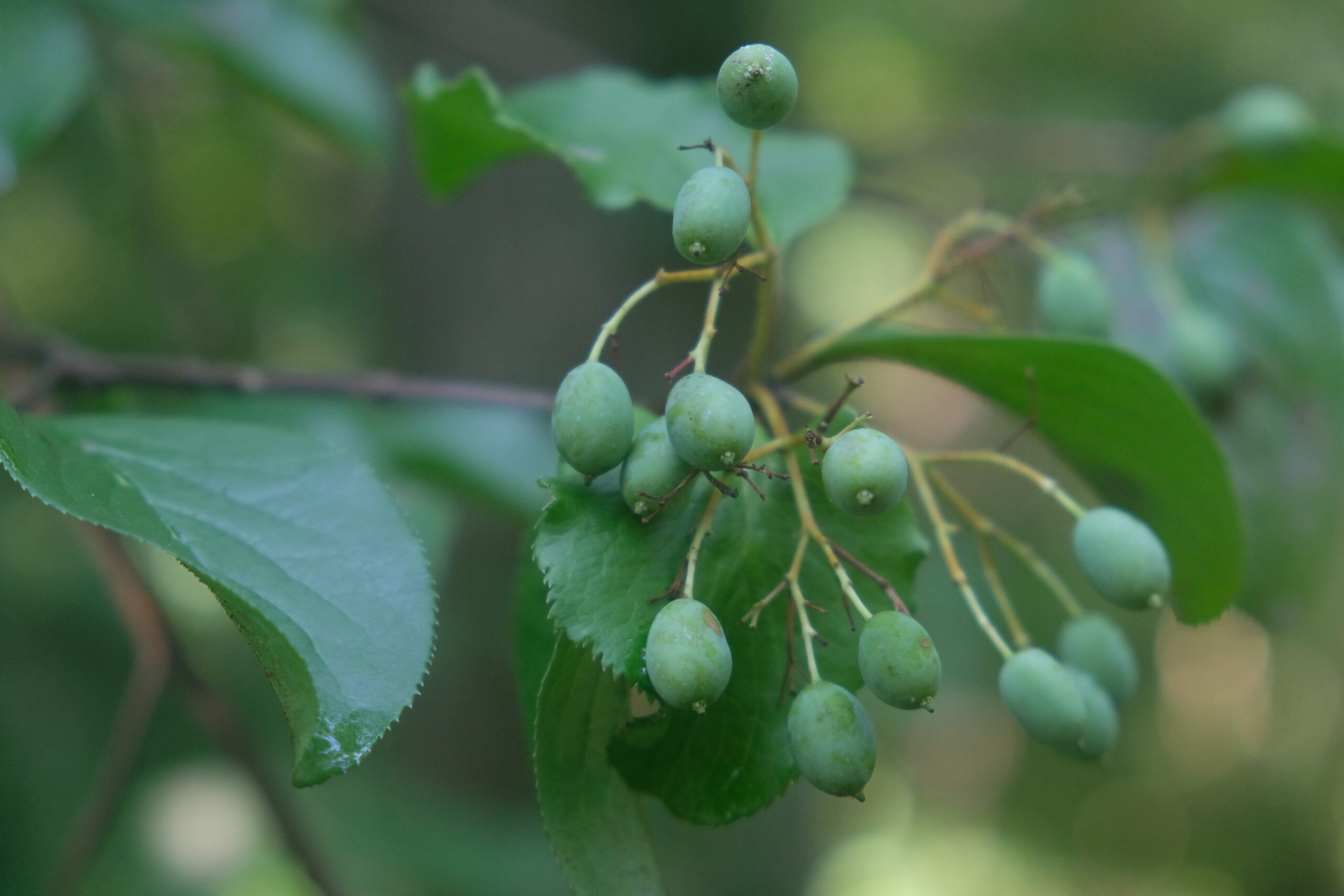
Viburnum rufidulum (Rusty Blackhaw)

Bloom Time: April to May

Sun Requirement: Full Sun to Part Shade

Water Requirement: Medium

Wildlife: Host plant for Azure Butterfly and fruit attracts songbirds, squirrels, and chipmunks

Tolerates: Deer resistant and drought tolerant once established

Native to North America: Yes

Zones: 5 to 9

Other: This native small tree has clusters of white flowers in the spring and blue fruits that attract wildlife in the summer.

Location: Sculpture Trail

Viburnum rufidulum

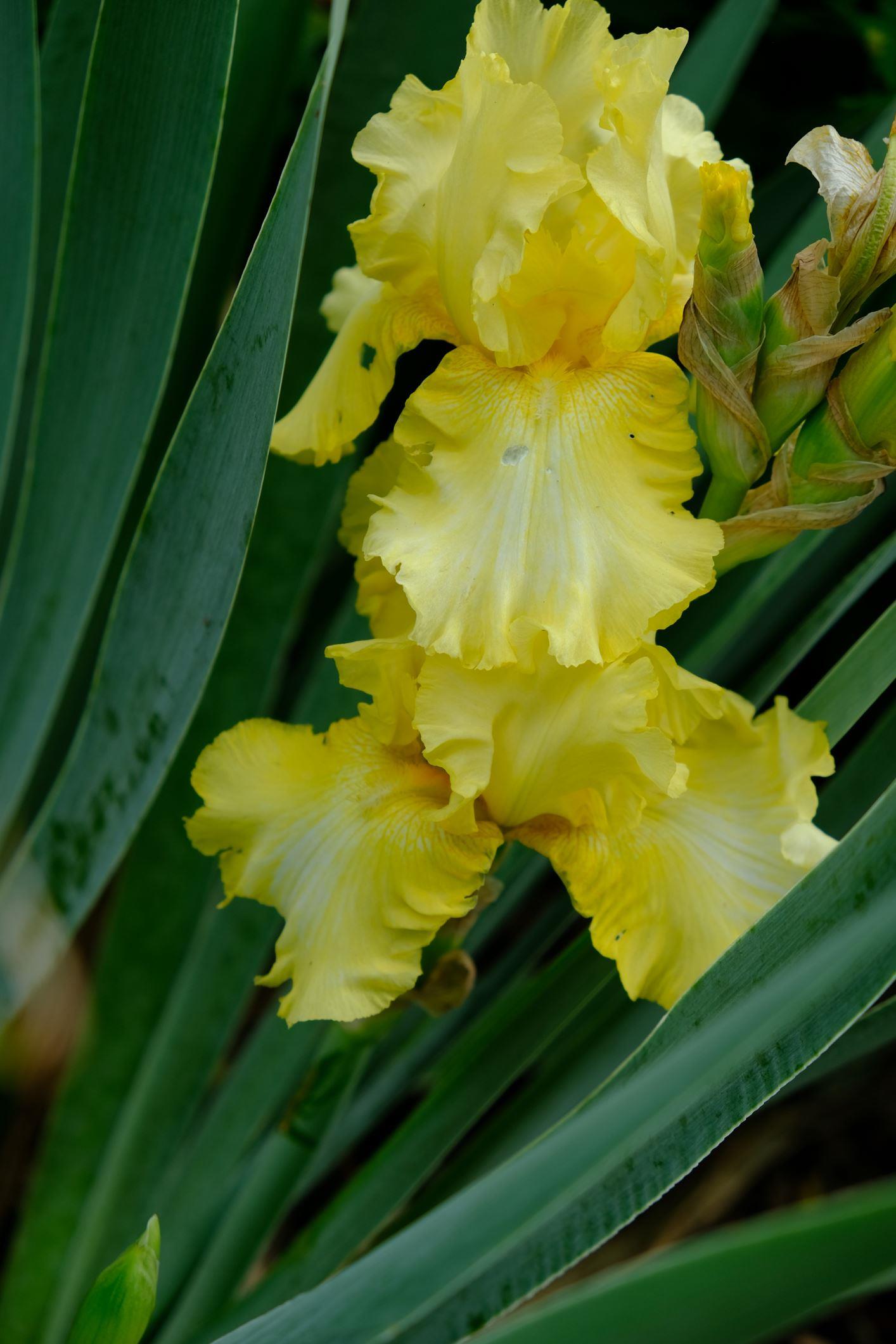
Iris ‘Summer Olympics’ (Summer Olympics Iris)

Bloom Time: April to August

Sun Requirement: Full Sun

Water Requirement: Medium

Wildlife: Attracts bumble bees and other pollinators

Tolerates: Deer and Rabbit

Native to North America: N/A

Zones: 3 to 9

Other: A reblooming iris that sports fragrant, elegant yellow flowers all summer.

Location: Wills Perennial Garden

O

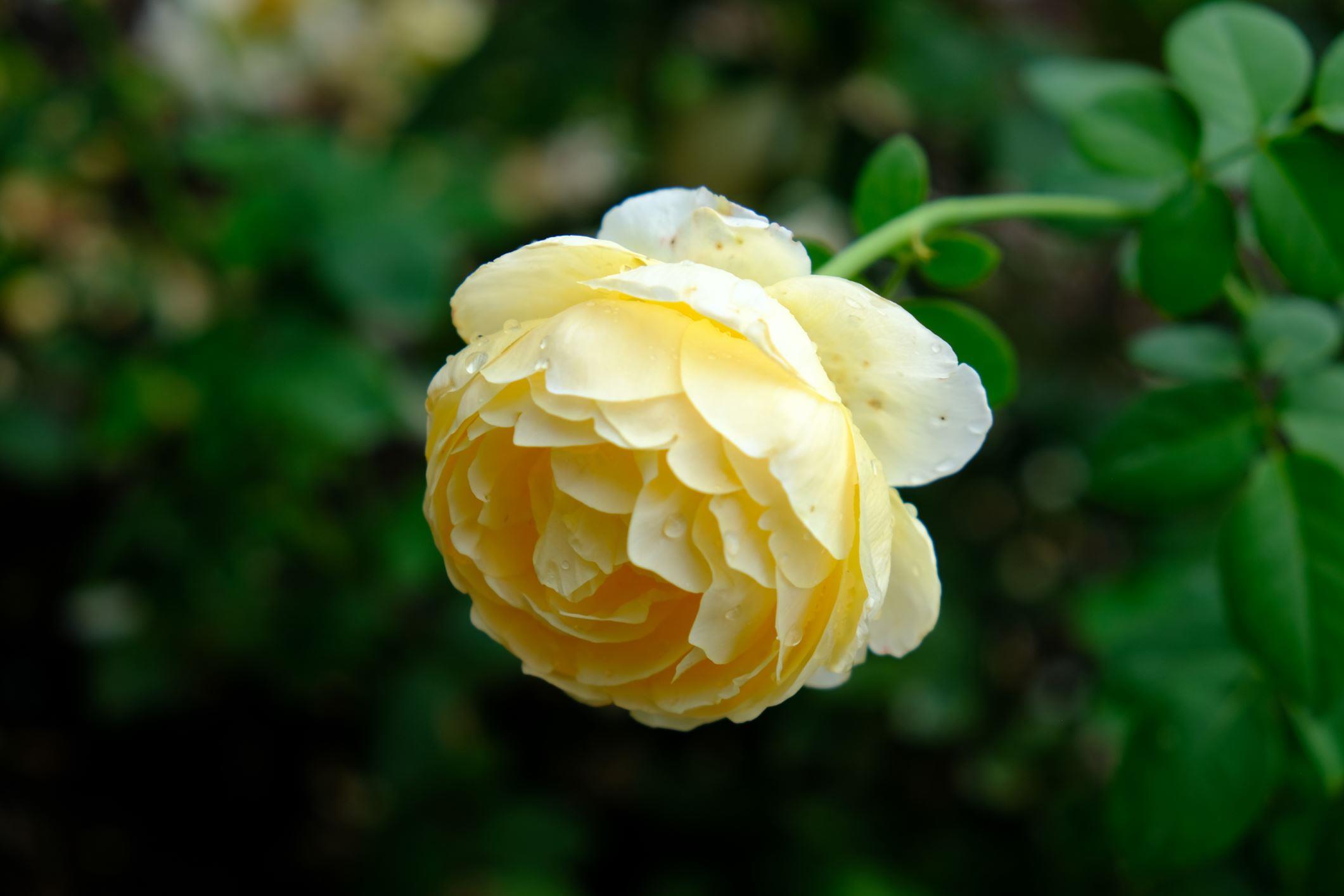
Rosa ‘Charlotte’ (Charlotte Rose)

Bloom Time: May to September

Sun Requirement: Full Sun to Part Sun

Water Requirement: Medium

Wildlife: Attracts butterflies

Tolerates: Performs well in both warm and cool climates

Native to North America: N/A

Zones: 4 to 10

Other: The cup-shaped blooms of this English rose are a lovely shade of soft butter yellow.

Location: Rose Study Garden

O

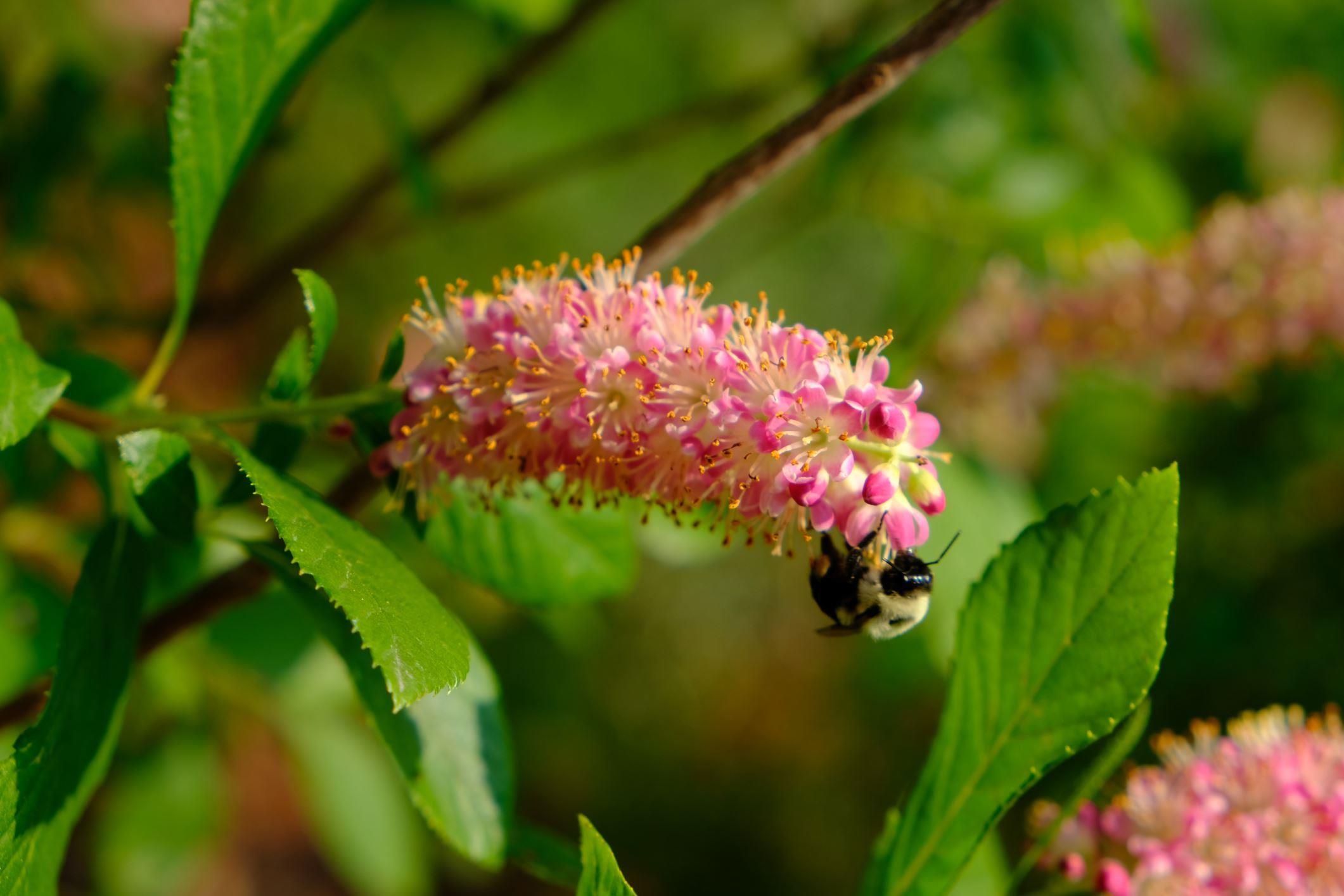
Clethra alnifolia ‘Ruby Spice’ (Summersweet)

Bloom Time: July to August

Sun Requirement: Full Sun to Full Shade

Water Requirement: Medium

Wildlife: Attracts hummingbirds and butterflies

Tolerates: Deer, Salt and Clay Soils

Native to North America: N/A

Zones: 3 to 9

Other: The delightfully fragrant bright pink flower spikes last up to six weeks on this deciduous shrub.

Location: Bracken Foundation Children’s Garden

O

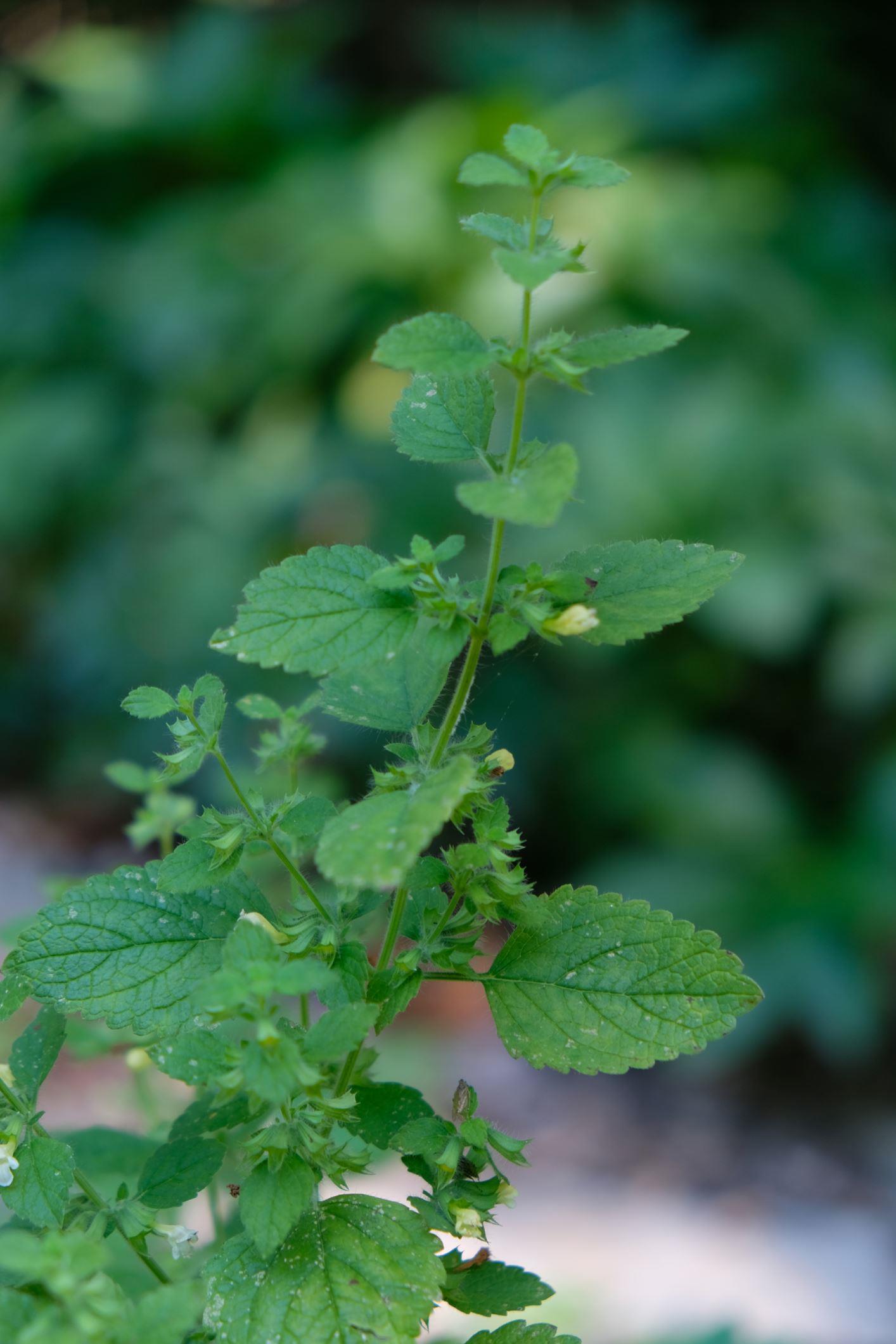
Melissa officinalis (Lemon Balm)

Bloom Time: June to August

Sun Requirement: Full Sun to Part Shade

Water Requirement: Medium

Wildlife: Attracts butterflies and bees

Tolerates: Tolerates poor soils and drought once established

Native to North America: No

Zones: 3 to 7

Other: A culinary herb with lemon-scented leaves, commonly used in tea, sauces, and baked goods.

Location: Herb Garden

O

Privacy Policy Sitemap Web design by Speak
Back to top