volunteer Archives - Page 2 of 3 - Cheekwood | Page 2
x icon Close
test

Sowing Seeds and Spilling Beans: The Wild World of Cabbages
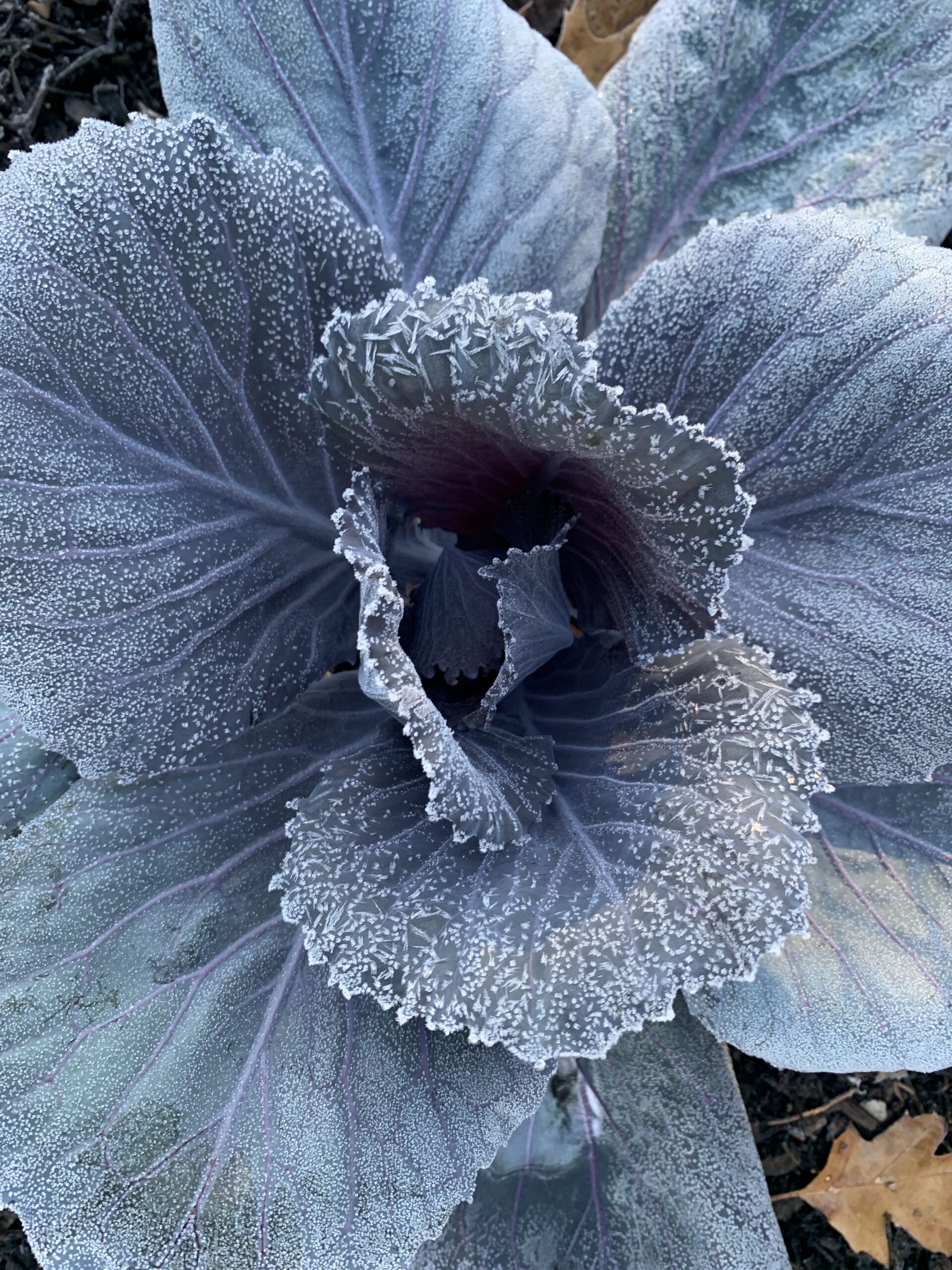
Featured Image: Frosty purple-hued cabbage.

Hello readers!

My name is Natasha, and I’m the Garden Educator at Cheekwood. My work here involves managing a raised bed vegetable garden (the Cheekwood GROWS Garden) and leading educational programming in this space. In this monthly blog series, I explore cultivated edible plants and our relationships with them in Middle Tennessee.

You may know Brassica oleracea by many names. Collard greens, broccoli, kale, cabbage, Brussels sprouts, kohlrabi – all these vegetables are of the same species, despite how different they appear. They thrive in cool weather and will survive light frosts with no protection necessary, which makes them great choices for an early spring vegetable garden.


When found in the wild, B. oleracea is known as wild cabbage. Its original home is the Mediterranean, where it grows along coastal limestone cliffs. To survive this harsh environment, B. oleracea stores lots of water and nutrients within its thick, waxy leaves, like a succulent. In its second year of growth, it uses that nutrient storage to produce bright yellow flowers and reproduce.

The nutrient density of wild cabbage was likely attractive to the people who first chose to eat and grow the plant. Who exactly these people were is difficult to trace. What is certain is that many farmers, across regions and cultures, selectively bred B. oleracea over thousands of years to produce an extraordinary variety of vegetables. While this is not an uncommon practice in agriculture (both beets and chard come from the species Beta vulgaris), B. oleracea provides the most striking example of the power of artificial selection. From this single plant we have developed many vegetables that are cultivars (cultivated varieties) highlighting different parts of the plant:

  • Collards and kale – bred by farmers for their leaves
  • Broccoli and cauliflower – these are large inflorescences (the flowering parts of the plant)
  • Cabbage – a massive terminal bud
  • Brussels sprouts – a collection of lateral buds (this is why they look like tiny cabbages)
  • Kohlrabi – a very swollen stem
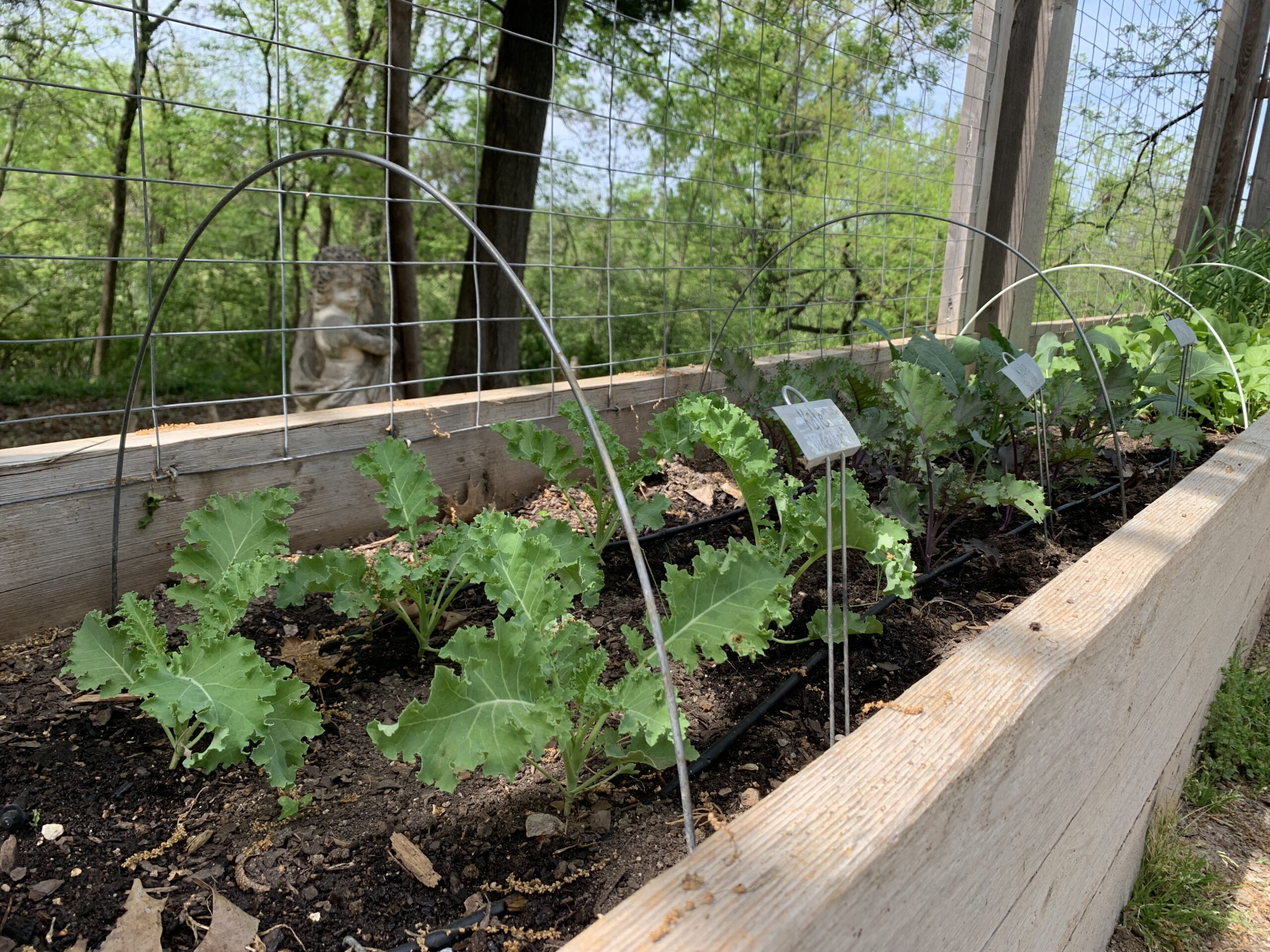
Springtime curly kale

Springtime curly kale.

These vegetables may be nearly genetically identical, but they are separated by cultural context. Cabbage, for example, has long been considered a subsistence crop, bred to have a long shelf life and sustain people through cold winters. Due to its high nutrient content, it was once used to prevent scurvy on long voyages at sea. As with all B. oleracea vegetables, cabbage arrived in North America along with European settler colonialism and has been a staple in regional cuisines ever since. Its popularity is tied to its affordability; in 2022, the USDA reported that cabbage was the cheapest fresh vegetable in grocery stores at about 80 cents per pound.
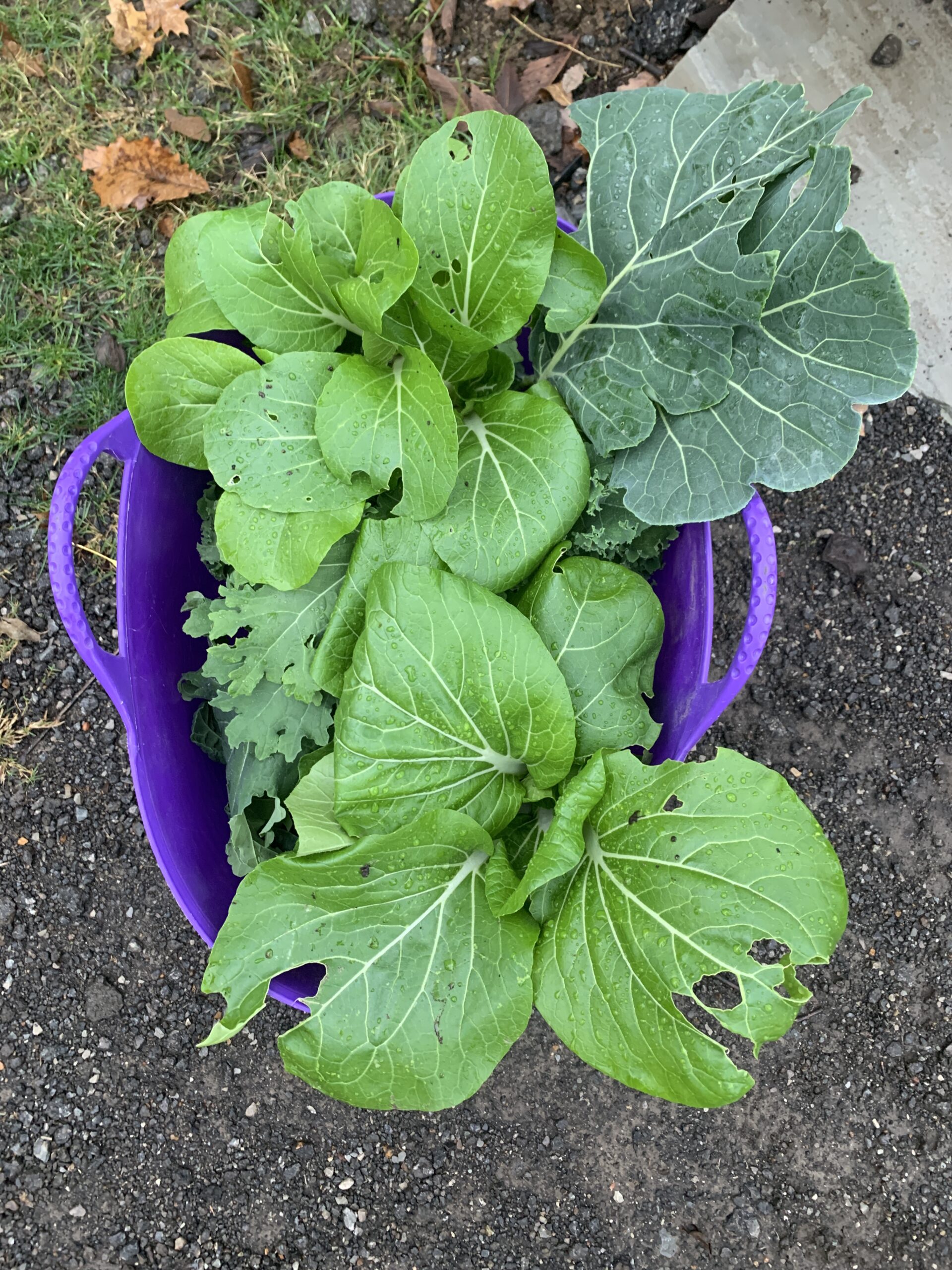

December harvest of cabbages

December harvest of collards, kale, and bok choy (a different brassica species, B. napa).

Collard greens also have a history of subsistence agriculture. Enslaved people laboring on plantations in the South relied on the food they grew in their vegetable gardens for survival. In addition to having little time or resources with which to grow this food, they were limited to growing a select few crops, collards being one of them. By braising collards with ham hocks, they brought the West African culinary tradition of stewed greens to the South and created a life-sustaining dish that remains a soul food staple to this day.

And then we have kale, relatively unknown in the United States until the 2010s, when it rocketed to stardom as a “superfood” touted by nutritionists, celebrities, and recipe bloggers alike for its many health benefits. The USDA reported that from 2007 to 2012, the number of farms growing kale increased from 1,000 to 2,500. Much of this growth happened in the South – today Georgia is second only to California in kale production.
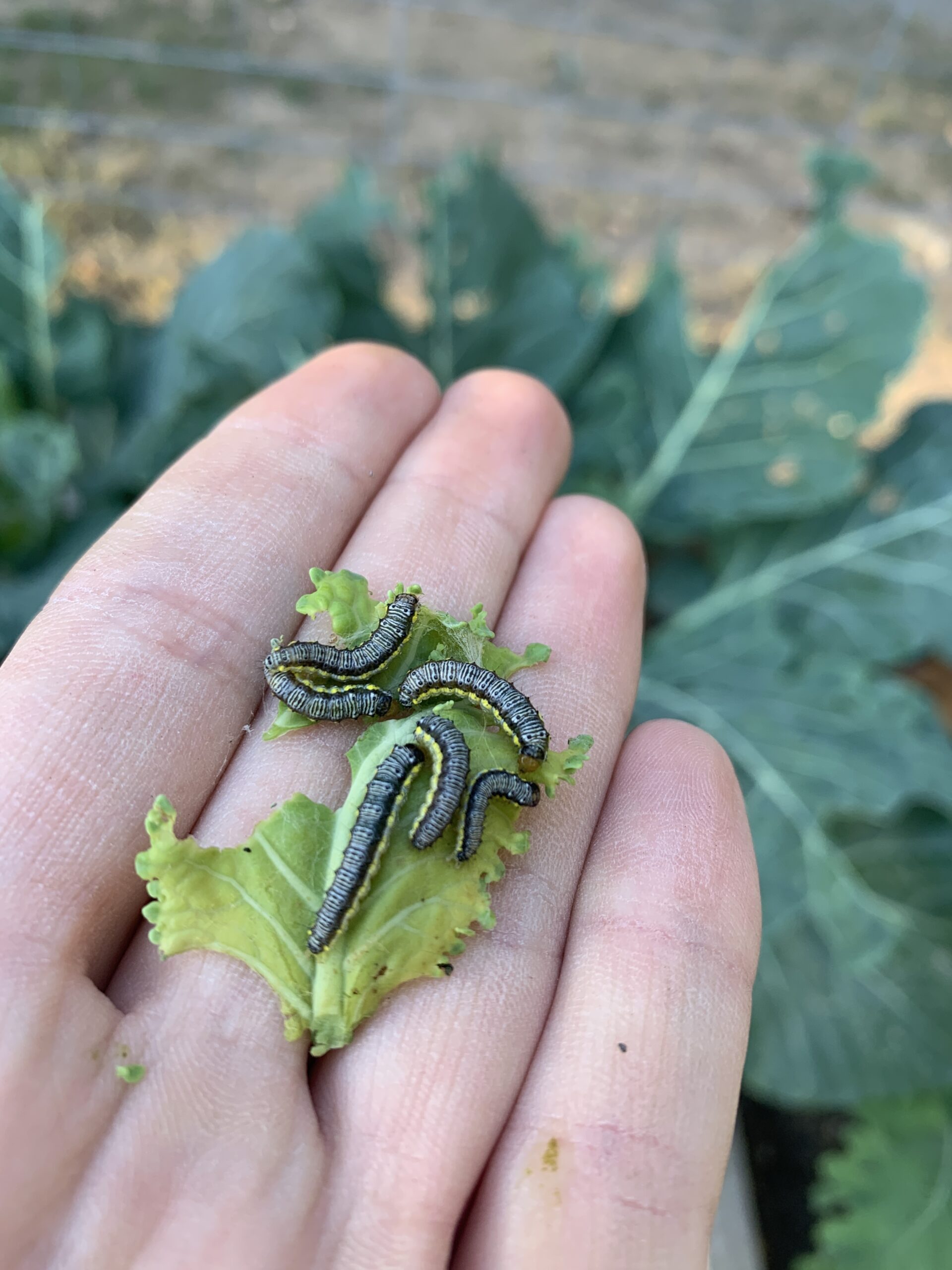
Caterpillars

Cross-striped caterpillars enjoying some collard greens.

But behind the expensive smoothies, salads, and grain bowls is a vegetable that, just like cabbage and collards, has historically fed rural communities. In Scotland, kale was once so widely consumed that the Scots word “kail” became synonymous with dinner. And yes, kale is a healthy vegetable with high concentrations of vitamins and protein. But other cultivars of B. oleracea don’t fall far behind in that regard. Where are all the cauliflower smoothies?

If you’re hoping to grow B. oleracea crops this spring, I recommend planting seeds outdoors as soon as your soil is workable (i.e., not frozen). Alternatively, you could start seedlings indoors in February and transplant them outdoors in March. Our cool season is short, and out of these veggies only collards are particularly heat tolerant. I like to cover brassica crops with protective netting until they are fully grown. This prevents small critters from gobbling the emerging seedlings, and protects growing plants from cabbage moths, who will lay eggs on the underside of brassica leaves that quickly turn into hungry caterpillars. Happy gardening!


Kale Pesto

All B. oleracea crops contain chemical compounds called glucosinolates, which hang out inside the plant’s cells until a pathogen, insect, or herbivore attacks. As soon as the cells are damaged, glucosinolates undergo a chemical reaction and turn into mustard oils. These pungent compounds are unpleasant and sometimes toxic to many insects that would otherwise eat brassicas.

By blending kale into a pesto, you are causing this chemical reaction to occur a million times over, all at once. Dramatic! But don’t worry  – in this recipe, the acidic lemon juice and rich parmesan cheese balance out the mustard oil bitterness of the kale.

Ingredients:

  • 2 cups kale, roughly chopped
  • 3 cloves garlic
  • 3/4 cup grated parmesan cheese
  • 1 cup walnuts
  • Juice of 1/2 lemon
  • 2/3 cup olive oil
  • Salt and pepper to taste

Instructions:

  1. Add all ingredients except olive oil to a food processor and blend until thoroughly combined.
  2. Slowly add olive oil through the chute of the food processor while continuing to blend.
  3. Adjust for seasoning, then serve with your favorite pasta or protein.

If you have questions, comments, or suggestions for future topics, you can contact me at ngibbs@cheekwood.org.

Sources:

  1. Fruit and Vegetable Prices, USDA, 2025, link
  2. Census of Agriculture Historical Archive, USDA, link
test

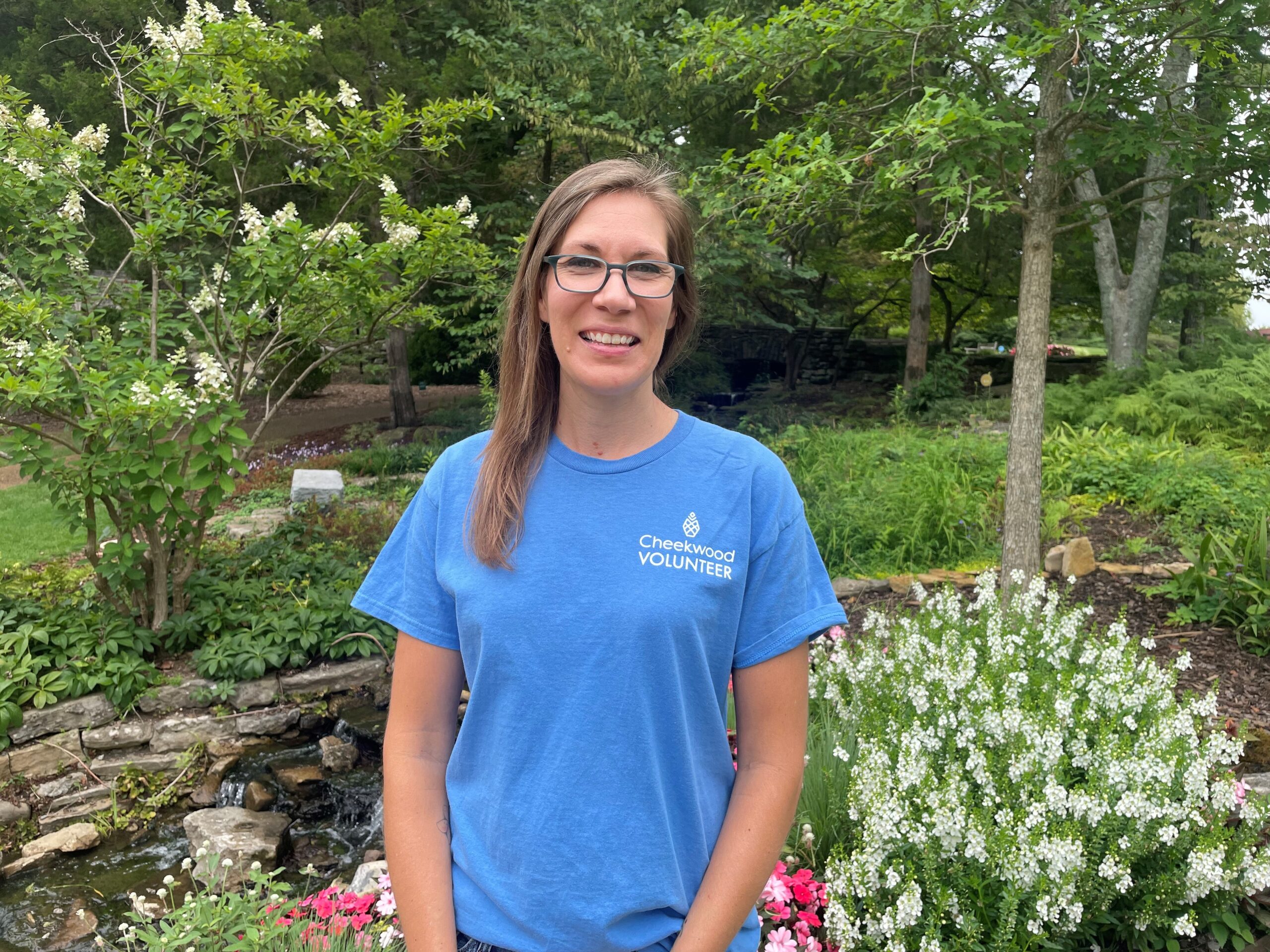
Volunteer Spotlight: Lisa Stone


Tell us a little about yourself and your background.

My husband and I moved to Franklin, Tennessee, from Texas eight years ago. Before that, I lived in various places from California to Massachusetts. I've worked for Bank of America for the last 16 years and plan to retire from there in about eight years. We have two children. Our son, James, and his wife, Linzi, live in Tampa, Florida. Our daughter Rachel recently moved to Atlanta to be closer to her boyfriend, Frank. We were all together for Thanksgiving plus our dog, Charlie, who is everyone's favorite, and had a great time. We toured Cheekwood Holiday lights for a great holiday memory with some great pictures too!

What are your favorite hobbies, activities, or interests?

My husband and I are very involved in our church, as our faith is very important to us. We also enjoy spending time with our family and friends, playing games, cooking, and listening to live music. Fortunately, living in Music City makes it easy to enjoy live music!

What is your favorite garden or area at Cheekwood and why?

I really like the Herb Garden at Cheekwood. It's a great place to go and just be quiet and enjoy the peace and quiet. It's hard to pick just one favorite garden, but this is definitely one of my favorites.

Do you have a favorite artwork at Cheekwood, or, if not, a favorite exhibition that Cheekwood has hosted? Is there a reason you like it?

I had so much fun this summer watching the children find the Trolls and then scream "TROLLS" as they ran up to them. It was truly a magical moment.

Why did you decide to become a volunteer?

I became a Cheekwood volunteer after attending an event sponsored by Bank of America in the fall of 2022. I had so much fun being outside among happy people that I signed up to be a volunteer. I've loved every minute of it, and it has become my happy place.

What have you enjoyed the most about your volunteer experience?

I especially enjoy talking to first-time visitors at Cheekwood. I love seeing their excitement and getting to know them. Since I've lived in so many places, I can usually find something in common with them.

Is there a funny or inspirational story you can briefly tell about your volunteer experience?

My husband was very sick in May of 2023. Thursday Night Out gave me a much-needed break from my caretaking duties and allowed me to get out of the house. Being outside in a beautiful setting with friendly, happy people and live music was just the medicine I needed to make it through another week.

Do you have any advice for individuals considering volunteering with Cheekwood?

I volunteer at Cheekwood because it's a fun and happy place to be. I like that there's no pressure to work certain hours, and I can choose the activities I want to be involved with. Also, each season is different, so I get to experience a variety of areas at Cheekwood.

For more information about volunteering visit our volunteer web page: www.cheekwood.org/support/volunteer

test

Sowing Seeds and Spilling Beans: Mexican Marigolds

Marigold Image 2

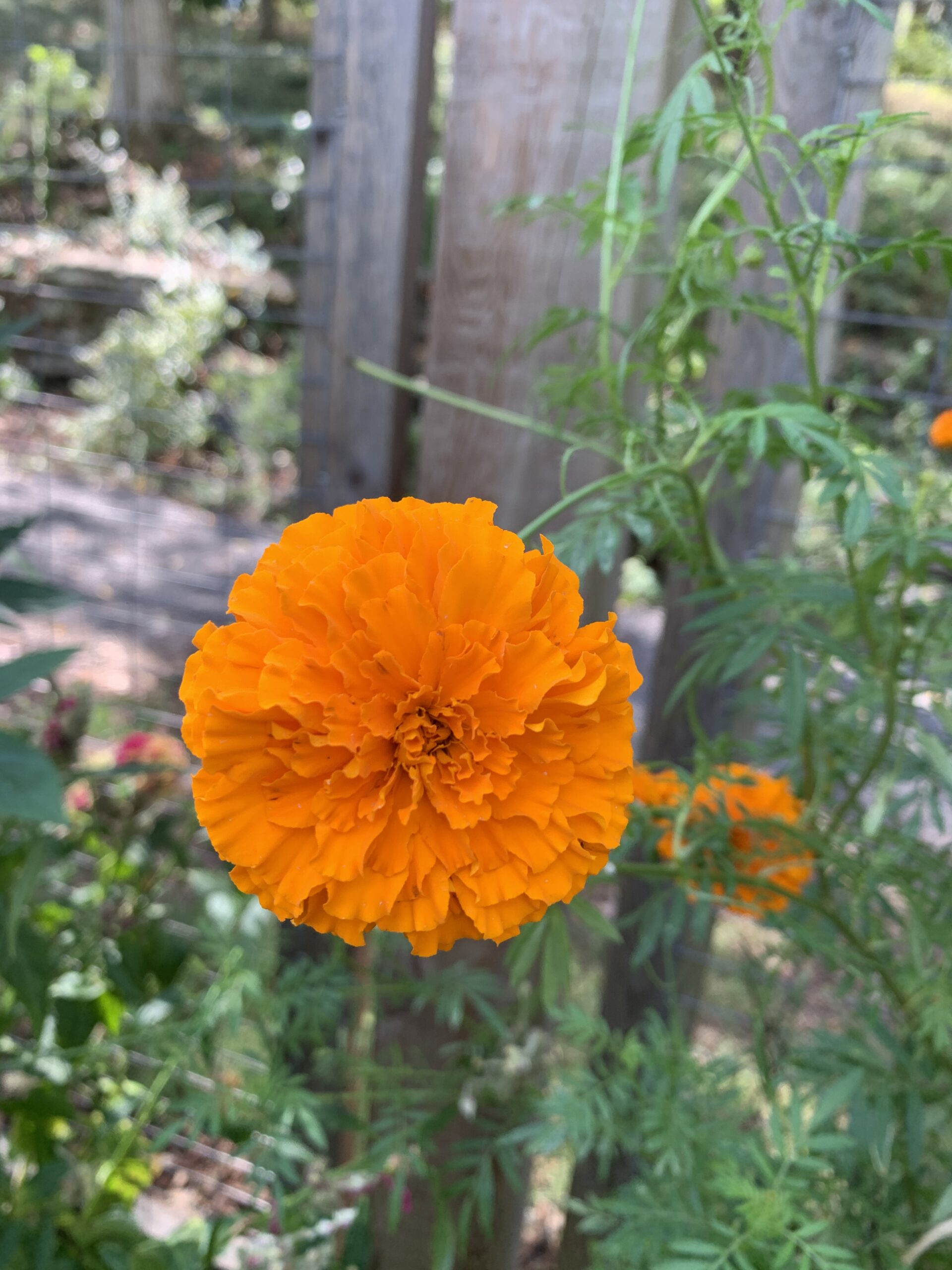
Featured Image: Close-up of a marigold in full bloom.

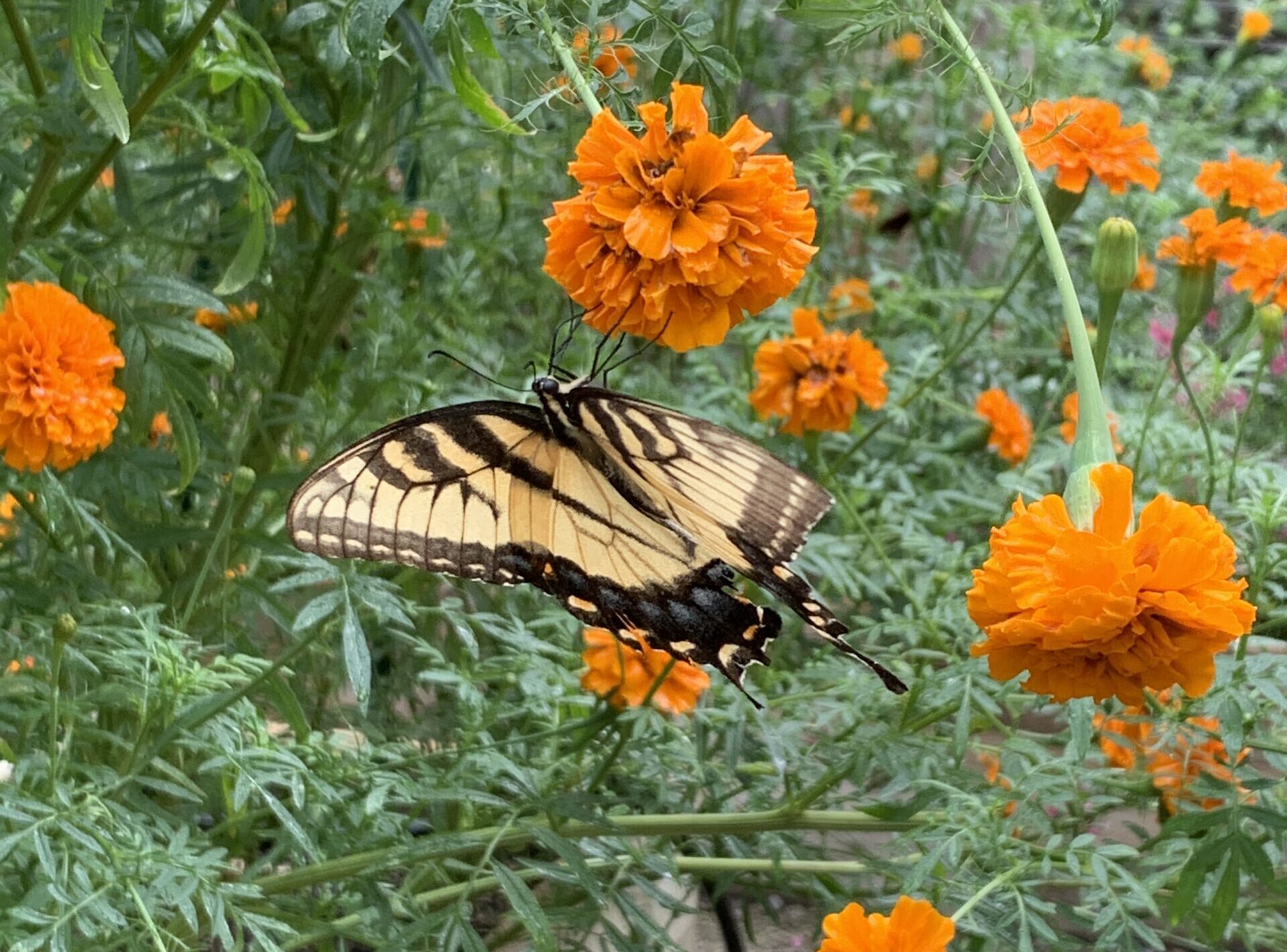
A swallowtail butterfly lands on a marigold.

Hello readers!

My name is Natasha, and I’m the Garden Educator at Cheekwood. My work here involves managing a raised bed vegetable garden (the Cheekwood GROWS Garden) and leading educational programming in this space. In this monthly blog series, I explore cultivated edible plants and our relationships with them in Middle Tennessee.

In Tennessee, marigolds are prolific and easy-to-grow annuals that put on a show all summer long. They are purported to keep pests out of a vegetable garden and are a favorite of butterflies and bees. While certainly not frost tolerant, they will happily bloom well into the fall and reseed for the following year. Just like many culinary herbs, they are edible yet conveniently undesirable to garden foragers such as deer and rabbits. The petals can be used to make herbal tea or tossed in a salad to add some zing.


There are around 50 species of marigold in the Tagetes genus, all of which are native to Central and South America. The showiest is Tagetes erecta, known most aptly by the common name Mexican marigold. I grow these in the raised beds of the Cheekwood GROWS Garden, where without fail they bend and snap under the weight of their own giant blooms and seem to fight against every attempt I make to stake them upright. I don’t mind, though, because their bright orange petals and intense, citrusy aroma are captivating, and it wouldn’t feel like summer without them.

Marigolds are orange because they contain high concentrations of carotenoids, a type of pigment that is also responsible for the vibrant colors of carrots, sweet potatoes, pumpkins, and deciduous leaves in the fall. Carotenoids are ubiquitous and essential in the world of plants; they help them survive high UV levels, attract pollinators, and complete photosynthesis.

The flower’s captivating scent comes from a complex cocktail of chemical compounds called monoterpenes (one of these monoterpenes is limonene, which can also be found in citrus fruits!). Strongly scented monoterpenes allow marigolds to deter predators – this is why gardeners will often plant marigolds among vegetables as a means of pest control.

Marigold Image 3

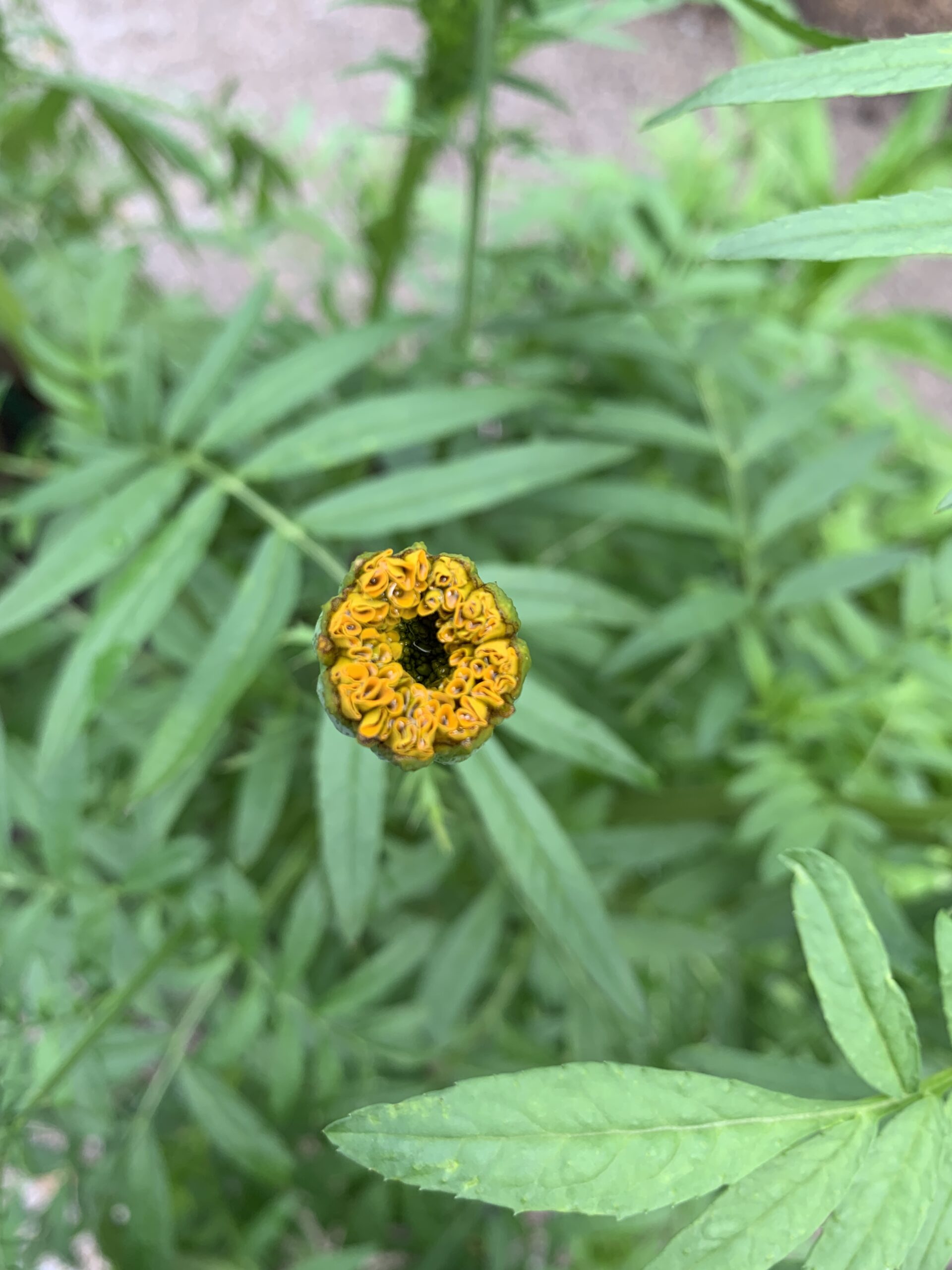
A marigold about to bloom.


In the case of the Mexican marigold, carotenoids and monoterpenes have an effect unrelated to biological function: Humans have valued and cultivated the brightly colored and scented flowers for hundreds of years. This is not an uncommon phenomenon – all cultivated plants have some sort of aesthetic, medicinal, or nutritional value – but Mexican marigolds have gained cultural importance around the globe, and I think that this is a lovely unintended consequence.

Tagetes erecta were cultivated by the Aztecs as well as the Mesoamerican civilizations that preceded them. In the Nahuatl language, the word for this flower is cempoalxóchitl, meaning “flower of 20 petals”– likely a reference to the plant’s ability to produce an abundance of intricate blooms. The Aztecs selectively bred cempoalxóchitl to develop large flower heads and vibrant colors, and used them extensively in medicine, celebrations, and rituals.

In the 16th century, Spanish colonizers took marigold seeds from the Aztecs back to Spain, and so began the plant’s globalization. They became popular ornamentals in gardens throughout much of Europe and quickly naturalized in North Africa. For this reason, British botanists mistakenly identified marigolds as indigenous to Africa, and the common name “African marigold” has stuck around among English speakers to this day1. Among European Christians, they became symbols of the Virgin Mary, giving us the name marigold (Mary’s gold). Spanish and Portuguese traders brought seeds to the Indian subcontinent, where marigolds quickly became a sacred flower integral to weddings, funerals, and festivals such as Diwali.

Today, cempoalxóchitl flowers play an important role back in their homeland of Mexico during El DÍa de los Muertos, a holiday honoring the lives of the departed and rejoicing in the temporary return of their spirits. The festivities take place at the beginning of November – notably around the same time as Diwali – and marigolds adorn the ofrendas (memorial altars) put together by families to celebrate loved ones. The flowers’ strong scent is believed to guide departed souls from the afterlife to the world of the living. This tradition can be traced back to pre-Hispanic times, when Aztecs used marigolds to honor Mictēcacihuātl, their deity of death, who guided spirits to and from the underworld.

Cheekwood’s 25th El Día de los Muertos festival will take place on November 2 and 3. In preparation for this event, I have been collecting and drying marigold blooms for the past few months and will be facilitating a seed saving activity from 10 AM – 2 PM on both days in the Cheekwood GROWS Garden. I invite you to visit and save some cempoalxóchitl seeds for your garden next year!

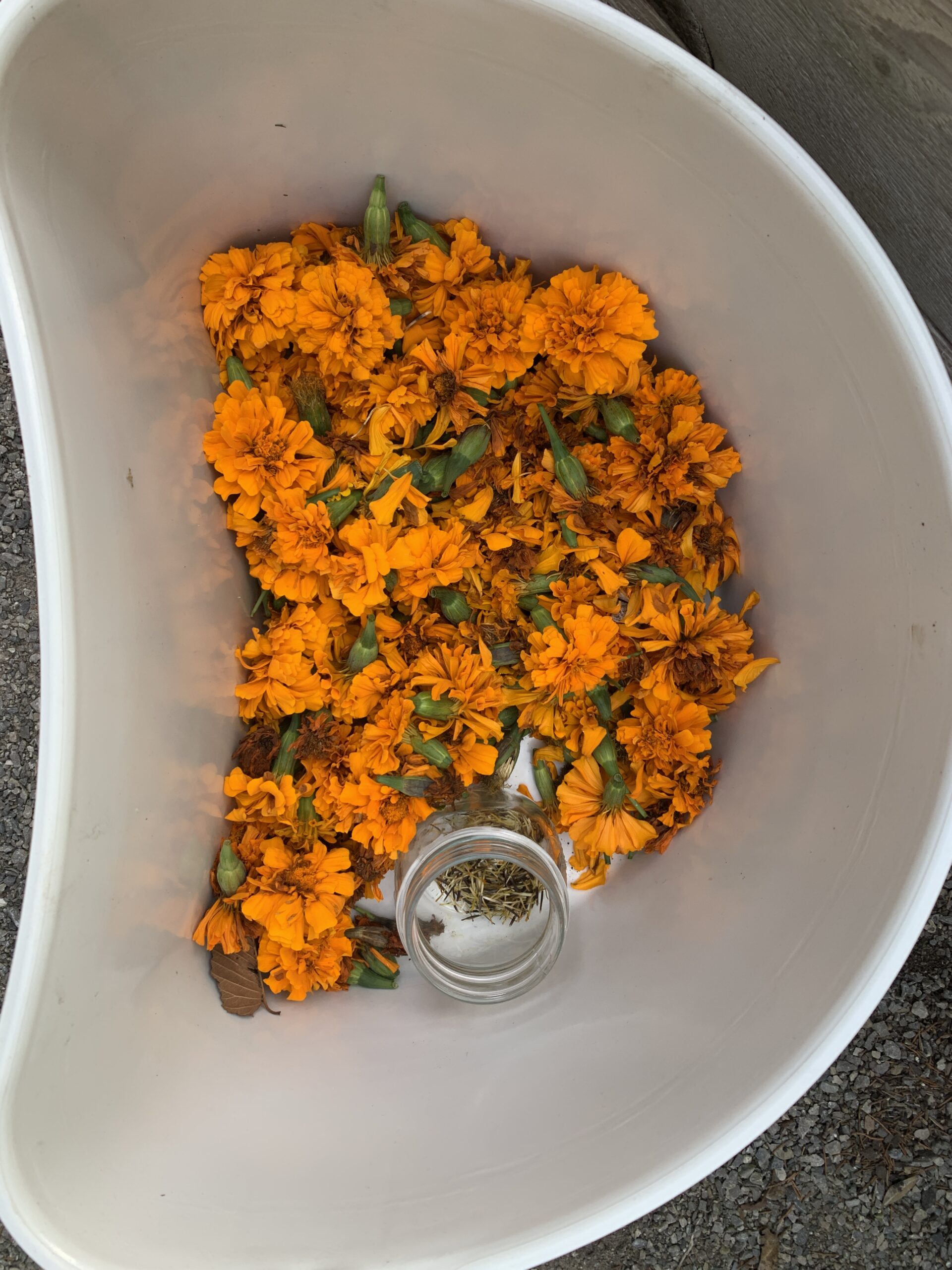
Marigold Image 4

Collecting marigold blooms for seed saving.

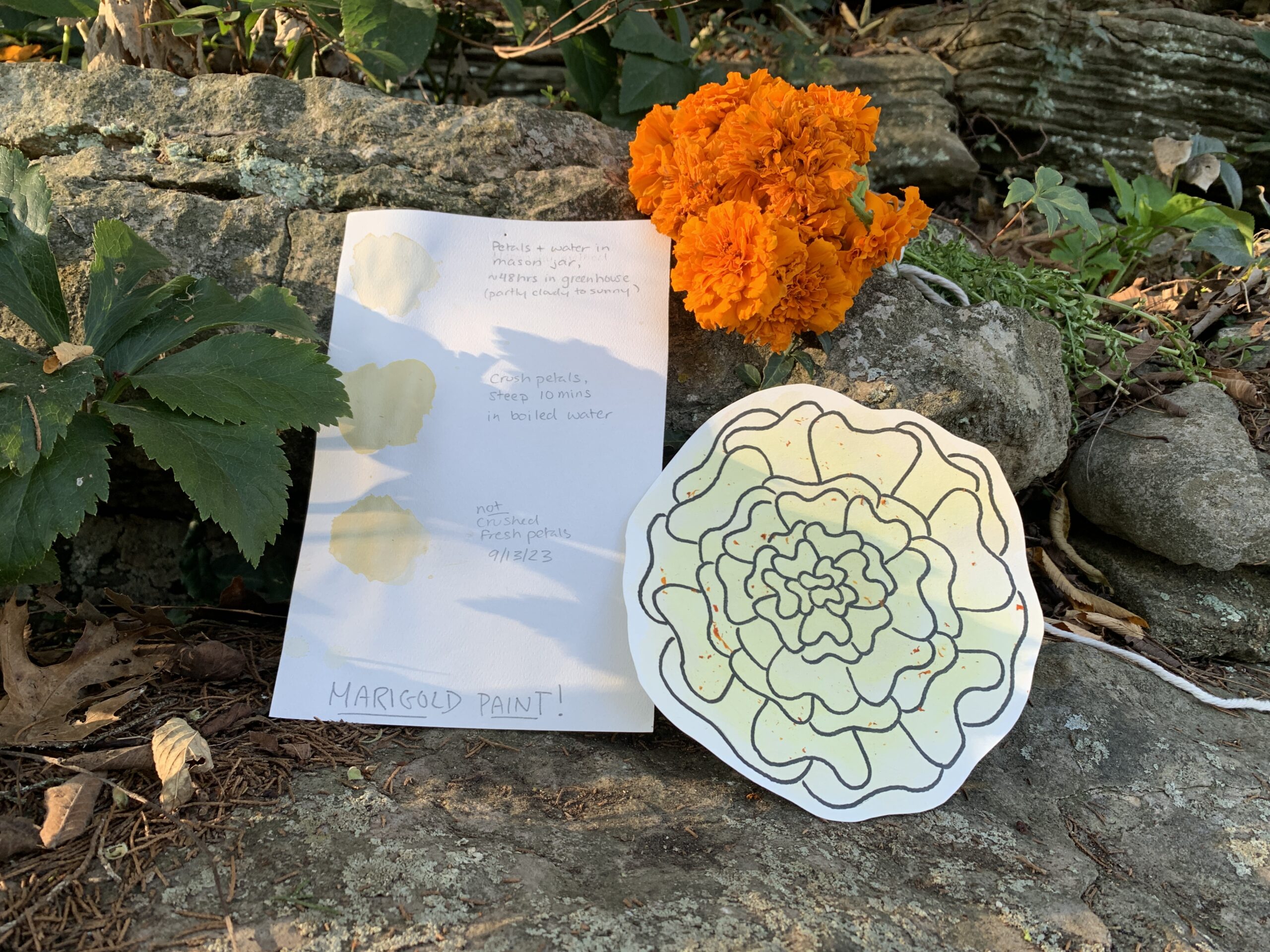
Marigold Image 5

Experimenting with marigold as a natural dye.


Painting with Marigolds

I’m no expert when it comes to natural dyes, but I love to experiment. The vibrant pigments in marigolds make them relatively easy to transfer to paper or fabric! You can do this in a few different ways:

  1. Crush some fresh petals, either with your hands or using a mortar and pestle. Once the petals have broken down and your hands (or the pestle) have turned orange, you’re ready to paint! Rubbing the crushed petals on watercolor paper will produce a bright yellow pigment flecked with orange.
  2. Stuff a mason jar to the brim with fresh petals. Boil some water and pour over petals to cover. Let rest for at least 10 minutes (but feel free to wait longer). Strain the petals out of the liquid and use like ink or watercolor. This method produces a less vibrant, but equally lovely, deep yellow shade.

If you have questions, comments, or suggestions for future topics, you can contact me at ngibbs@cheekwood.org.
Sources:

  1. Dalman, Nate. “Marigolds.” University of Minnesota Extension, 2022, link
test

Sowing Seeds and Spilling Beans: Harvesting Okra

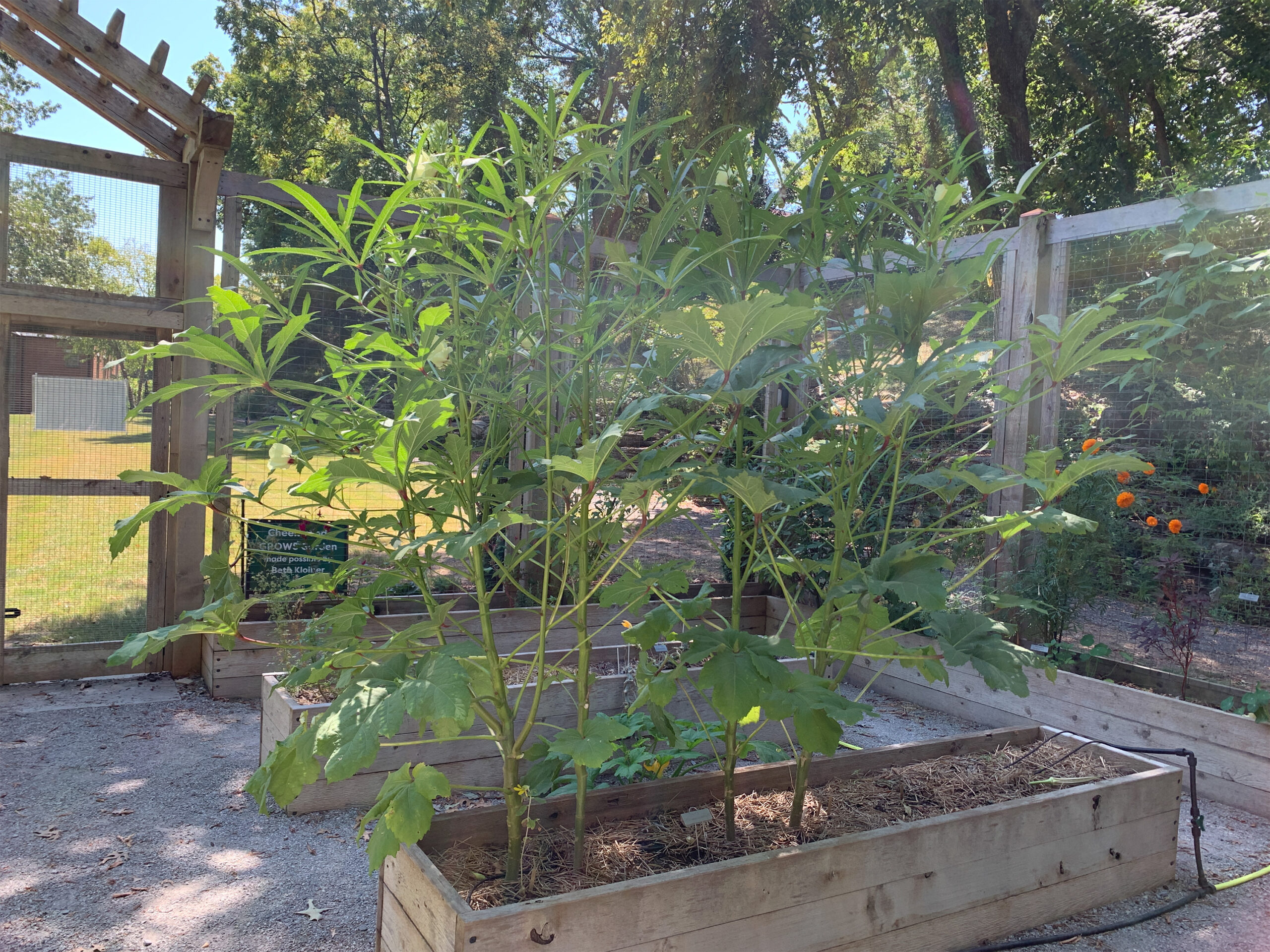
Okra Image 2_iOS

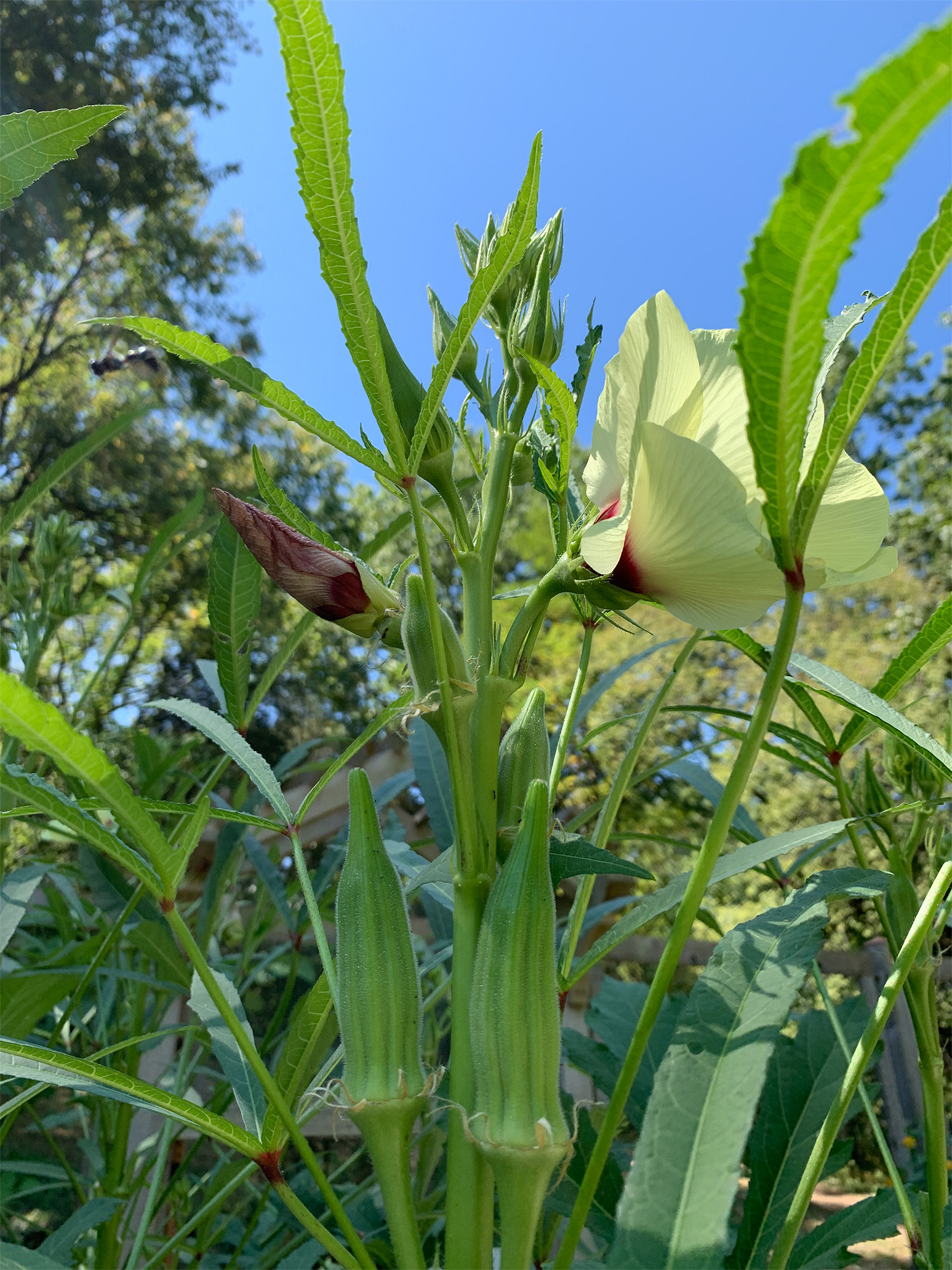
Featured Image: Okra plants in the Cheekwood GROWS Garden.

Okra fruits emerging on the plant.

Hello readers!

My name is Natasha, and I’m the Garden Educator at Cheekwood. My work here involves managing a raised bed vegetable garden (the Cheekwood GROWS Garden) and leading educational programming in this space. I’m excited to be starting this monthly blog series, in which I hope to explore cultivated edible plants and our relationships with them in Middle Tennessee.

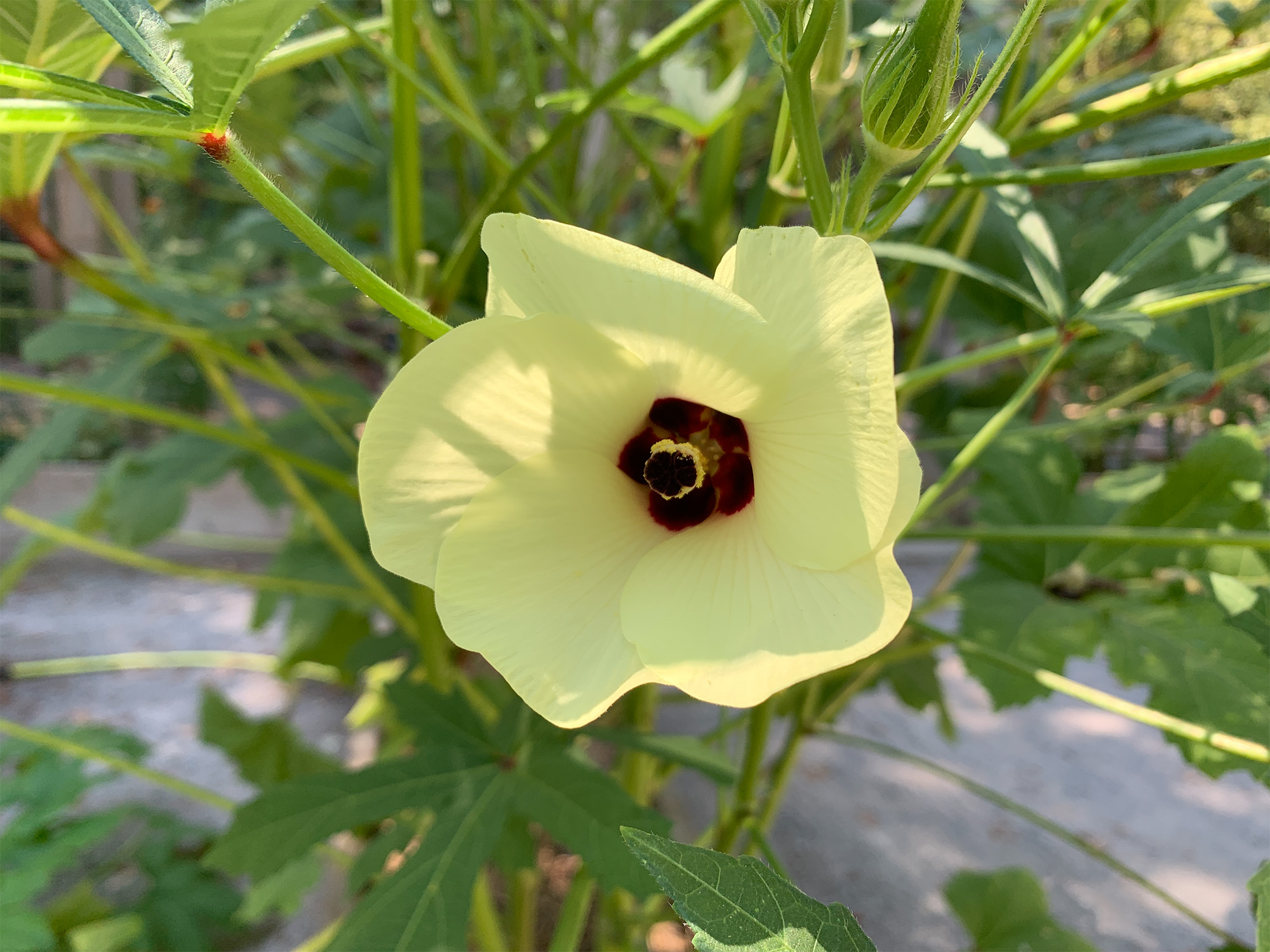
As summer begins to wind down, I have been thinking a lot about okra (Abelmoschus esculentus). A member of the mallow family (Malvaceae), hibiscus, cotton, and cacao are among its relatives. With its vigorous growth habit and ephemeral, red-tinged flowers, okra is a joyful plant. It thrives in heat, tolerates poor soil, and rarely faces significant pest or disease issues. The flowers only bloom for a single day, after which they quietly fall off the plant to reveal tiny fruits emerging behind them. Okra stands tall and strong with no staking necessary and will produce an abundance of these tasty fruits that can be prepared and eaten in countless ways – provided you catch them before they turn woody and tough, a change that will occur before you know it (i.e., in 4-5 days)!

Okra has ancient origins. The plant was first collected from the wild and cultivated over 3,000 years ago in the Abyssinian center of origin – a region encompassing present-day Ethiopia and parts of Somalia, known as an ancient agricultural hotspot. Wheat, sorghum, broad beans, and coffee are other significant crops now grown around the world that can be traced back to this biodiverse center of origin.

From there, okra spread around the world. It is an important ingredient in cuisines throughout the Indian subcontinent, the Middle East, and West Africa. It was enslaved Africans who brought okra – along with thousands of years of agricultural and culinary tradition –  to North America as a means of cultural preservation and survival. They grew the plant as a food crop in the American South, where it thrived in the rich soils and heat just as it did in its place of origin. Okra quickly became a staple of Southern cuisine and important food crop of the African diaspora.


Distinct okra recipes developed across the South in response to diverse cultural influences, from Creole gumbo in Louisiana to the okra and tomato stew of the Gullah Geechee people along the Southern Atlantic coast. Something that all okra recipes contend with in one way or another is one of its unique botanical features: the slime it secretes when cut open. The scientific term for this gelatinous substance is mucilage, and it acts as a lubricant to help okra plants efficiently transport and utilize water – a definite advantage in hot weather.

In gumbo, the slime acts as a thickener, giving the dish its signature mouthfeel. Pickling okra achieves the opposite effect, as the acidity from the brine cuts the gooeyness of the slime. Fried okra lands somewhere between these two; exterior crunch and interior slime balance each other out. I am a fan of all three, and welcome okra’s unusual mouthfeel as something truly unique among the vegetables widely available in this country.

Okra Image 3_iOS

Okra flower up-close.


As mentioned earlier, okra has a short harvest window and is best picked when the pods are about 3 inches long. I, however, have forgetful gardening tendencies and collected pods of all sizes this growing season. The slightly larger pods are still delicious but benefit from a longer cooking time; I like to halve them lengthwise and roast them in the oven. The very large pods contain jumbo white seeds – these can be removed and gently toasted in a pan with seasonings of your choice for a tasty snack! Okra is also perfectly edible, and in fact very delicious, freshly picked off the plant. It has a wonderful crunch that tends to fade during cooking.

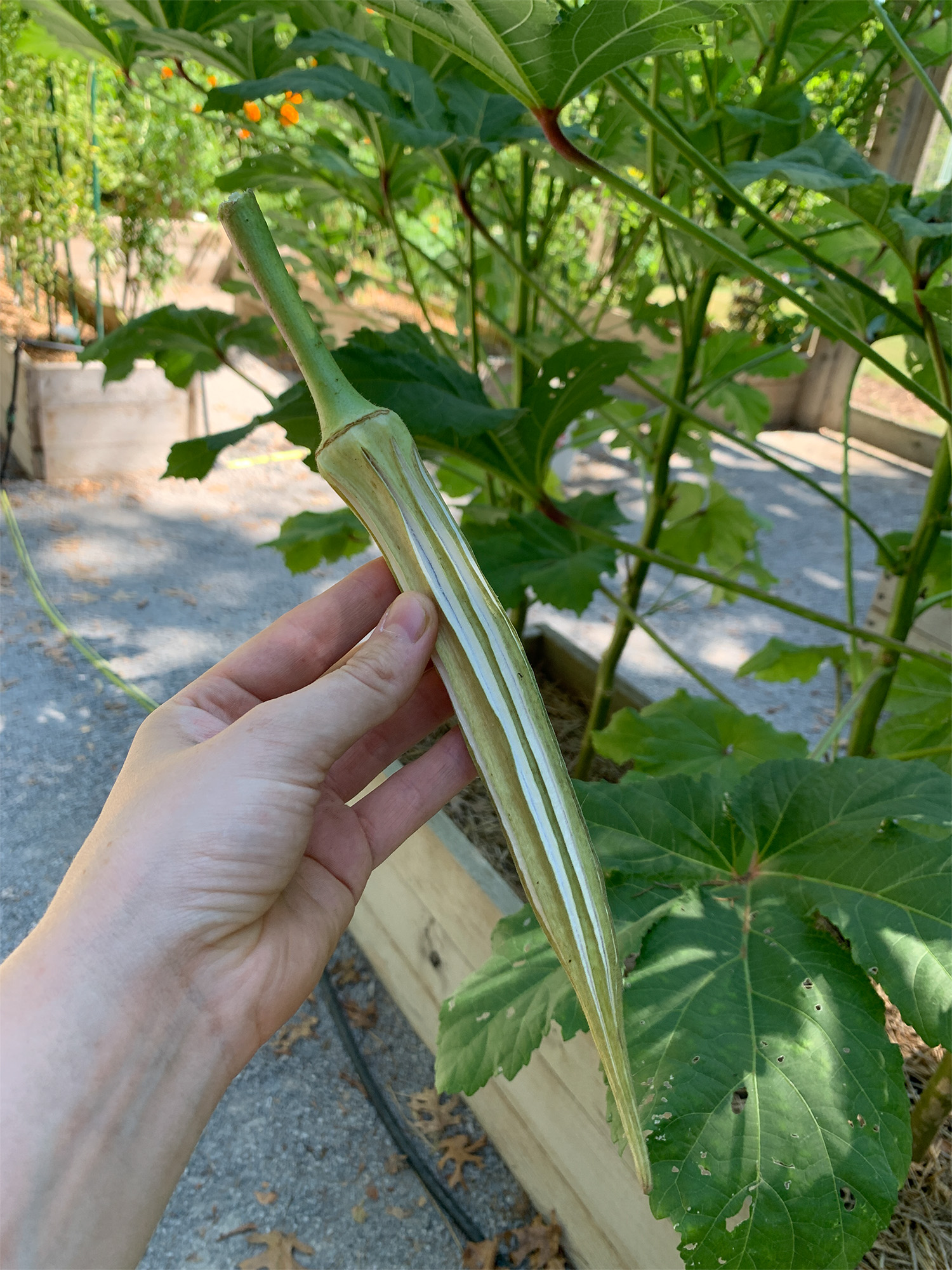
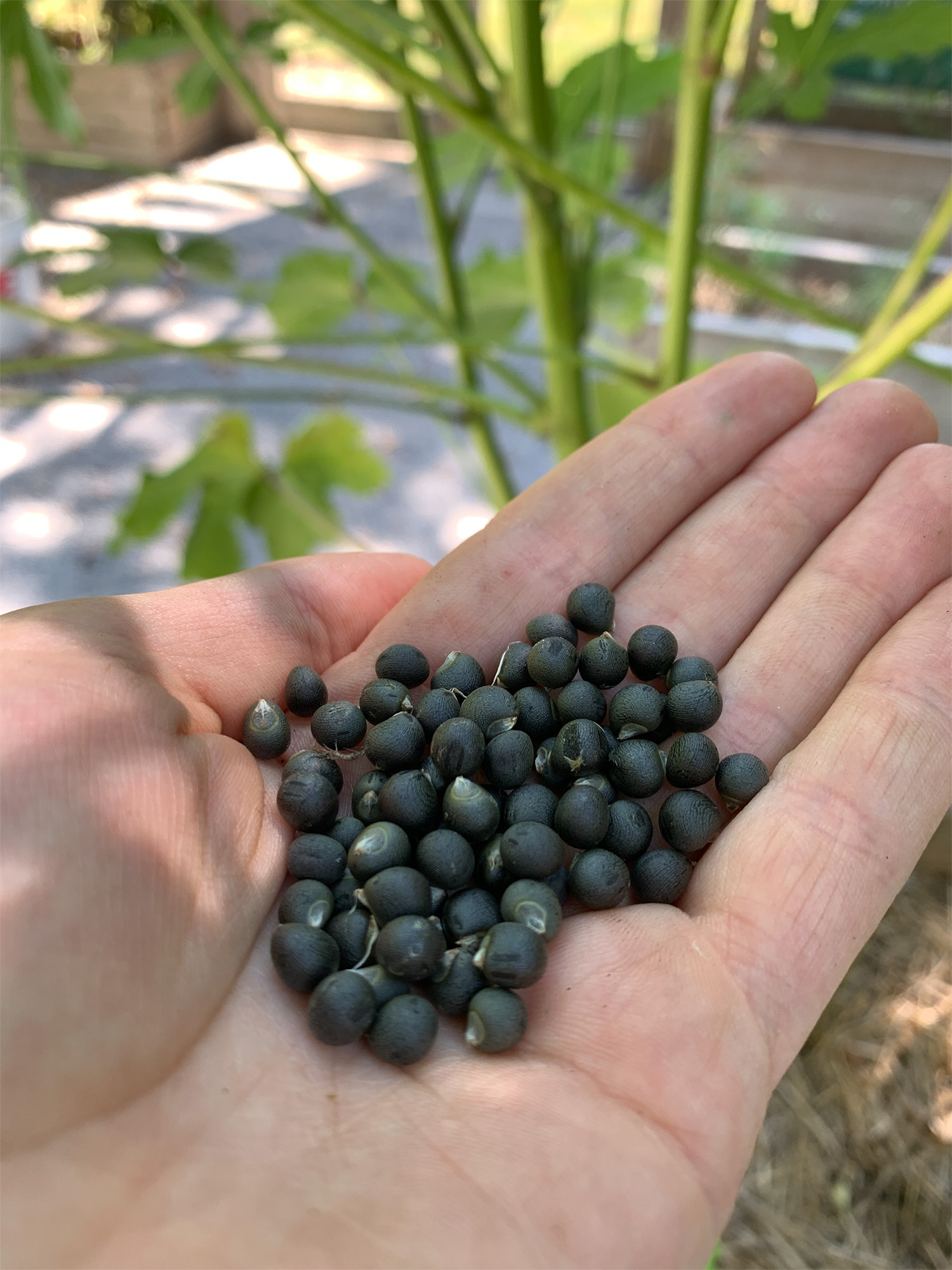
If you hope to save okra seeds for the following year, leave a few pods on your plant to grow huge and dry out. Towards the end of the summer, the ridges on these pods will become more pronounced and the green color will fade to white in between these ridges. At this point, you can harvest the pods, split them lengthwise, and remove the seeds within. You’ll know that they’re ready to save because they’ll have turned from a pearly white to a deep, green-tinged black. Since okra flowers are self-pollinating (both male and female parts exist in a single flower), the seeds you collect should produce the same variety you grew originally. Happy gardening!

Okra Image 4_iOS

Okra fruit that has dried out on the plant.

Okra Image 5_iOS

Okra seeds collected from dried-out pods.


Quick Fridge-Pickled Okra

Makes one 16-ounce jar

Ingredients

  • 8 oz fresh okra (10-15 pods, depending on size)
  • 3 cloves garlic, peeled and smashed
  • 1 fresh chile, split lengthwise, or 1-2 tsp dried chile flakes
  • 1 sprig fresh basil
  • 1 tsp black mustard seeds
  • 1 tsp black peppercorns
  • 1.5 tbsp granulated sugar
  • 1 tbsp kosher salt
  • 1 cup white vinegar
  • 0.5 cup water

Instructions

  1. Combine vinegar, water, sugar, and salt in a small saucepan. Simmer on the stovetop until sugar and salt have dissolved completely.
  2. In a clean, 16 oz mason jar, add okra, garlic, chile, basil, mustard seeds, and peppercorns.
  3. Pour heated brine over the vegetables and seasonings to fill the jar.
  4. Let the jar come to room temperature, then seal and refrigerate for at least 48 hours.
  5. Enjoy!

Thank you for reading my very first blog post.

If you have questions, comments, or suggestions for future topics, you can contact me at ngibbs@cheekwood.org.
test

2024 Summer Intern Blog


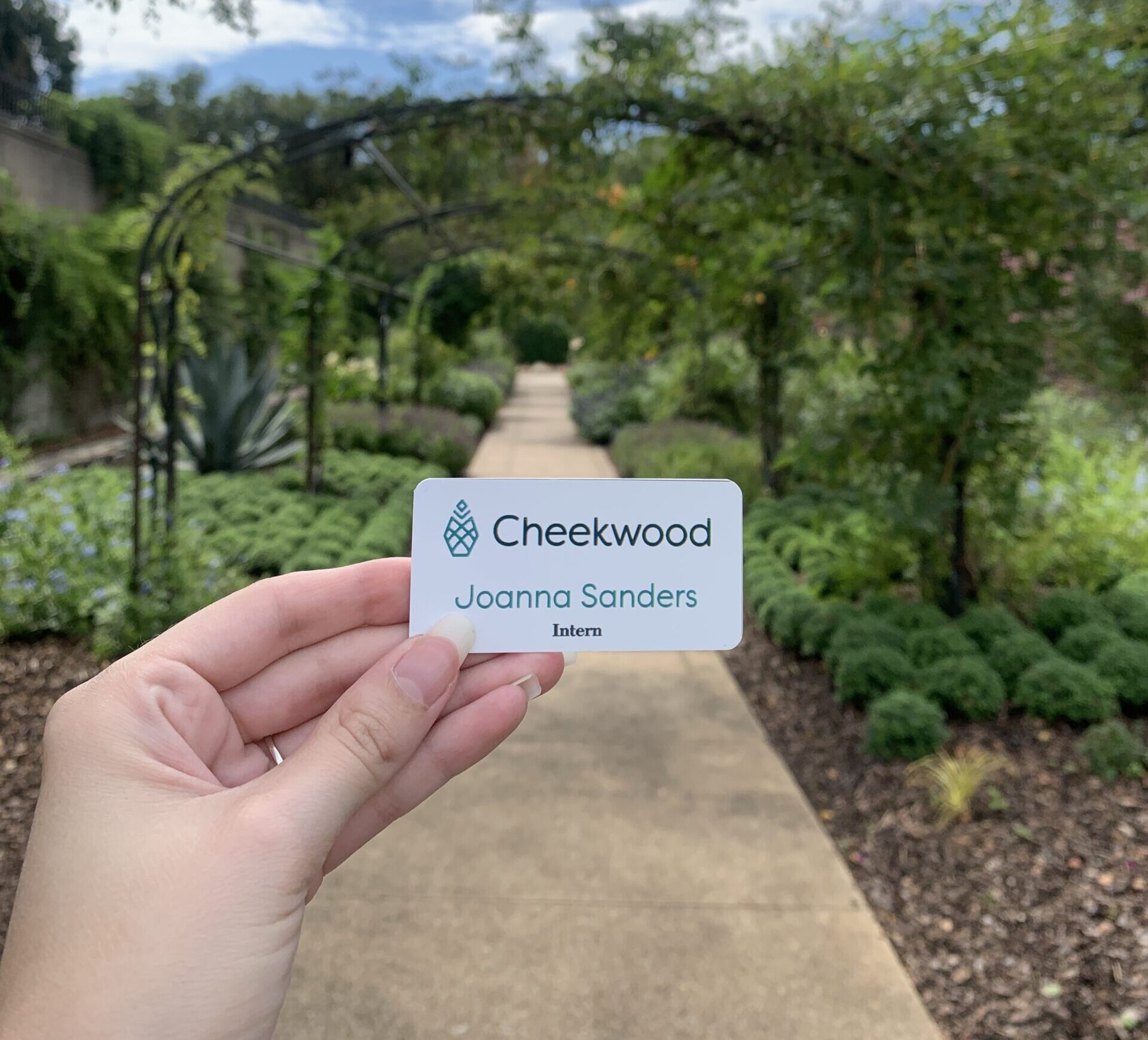
Photo 3_Joanna Name Tag

Digital Marketing Intern Joanna Sanders recaps her experience at Cheekwood.

Hello! I’m Joanna Sanders, and I had the wonderful opportunity to be Cheekwood’s Digital Communications Intern this summer. As a recent graduate with a degree in Journalism and a minor in Interactive Media from Middle Tennessee State University, I’ve built a diverse skill set in journalism, social media, and public relations. My journey has included meaningful work with local nonprofits like Corner to Corner and Craft Content Nashville, as well as a role as a Junior Publicist Intern at Music City Media on Music Row. One of my proudest achievements was seeing my story about Vietnam War veterans who are also renowned artists featured on the cover of The Daily News Journal. All these experiences have led me to Cheekwood, and I’m deeply grateful to contribute here.

Why did you want to be a Cheekwood intern?

As a Nashville native, Cheekwood has always held a special place in my heart. When I discovered this internship, it perfectly aligned with my career goals and passion for working with a beloved local nonprofit. Applying was a no-brainer, and I’m thrilled I did. This internship has not only enhanced my multimedia skills but also deepened my appreciation for nature, art, and the dedicated people who preserve them.


What is my favorite garden?

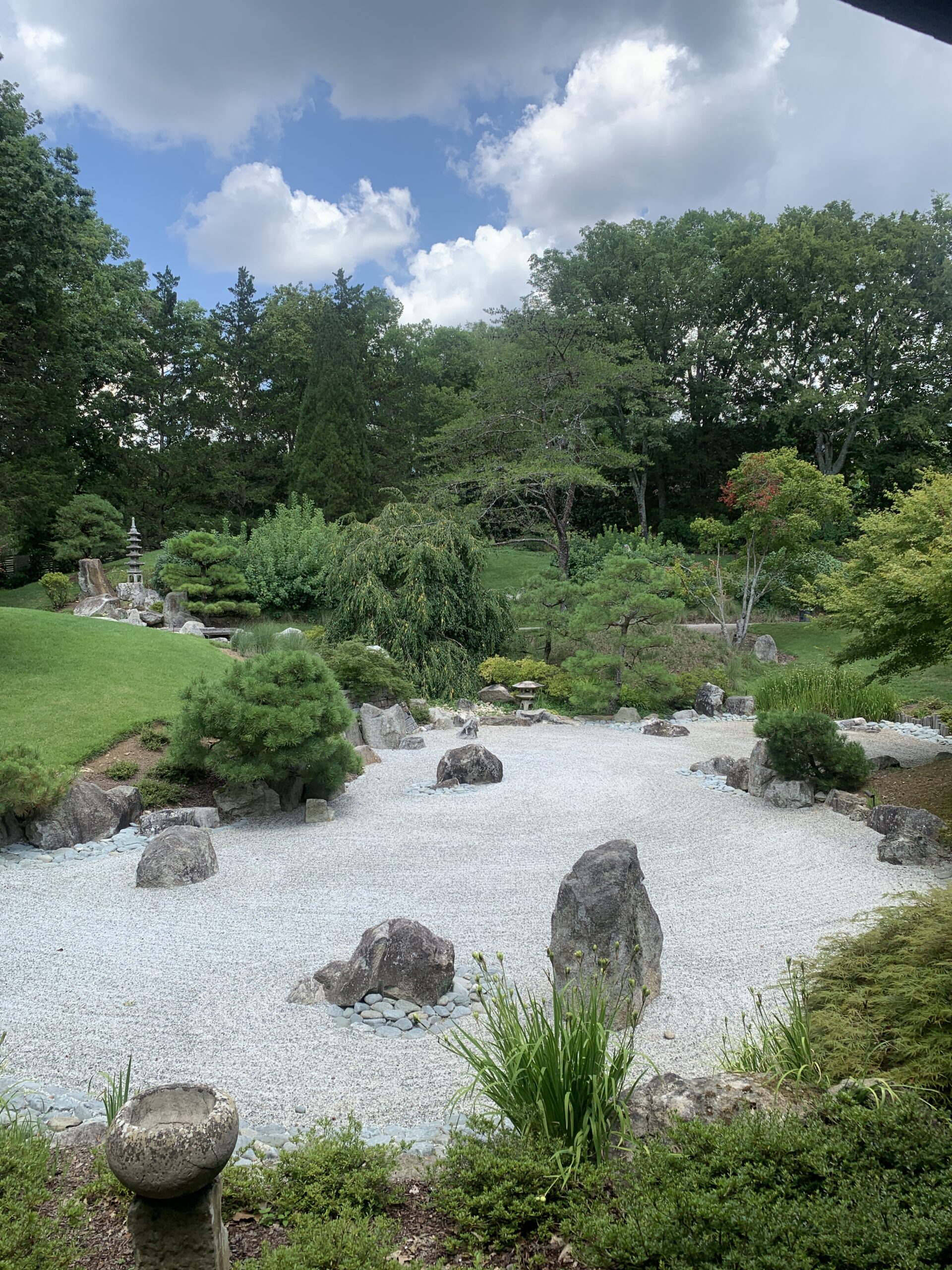
My favorite garden is the Blevins Japanese Garden. From the viewing pavilion, it reveals a breathtaking panorama unlike any other I’ve experienced. The bamboo trail and the soothing water fountain cultivate a unique atmosphere of tranquility. With a bit of luck, you might spot wildlife, including deer with their fawns or playful chipmunks roaming through the serene landscape.

What does an average day at Cheekwood look like?

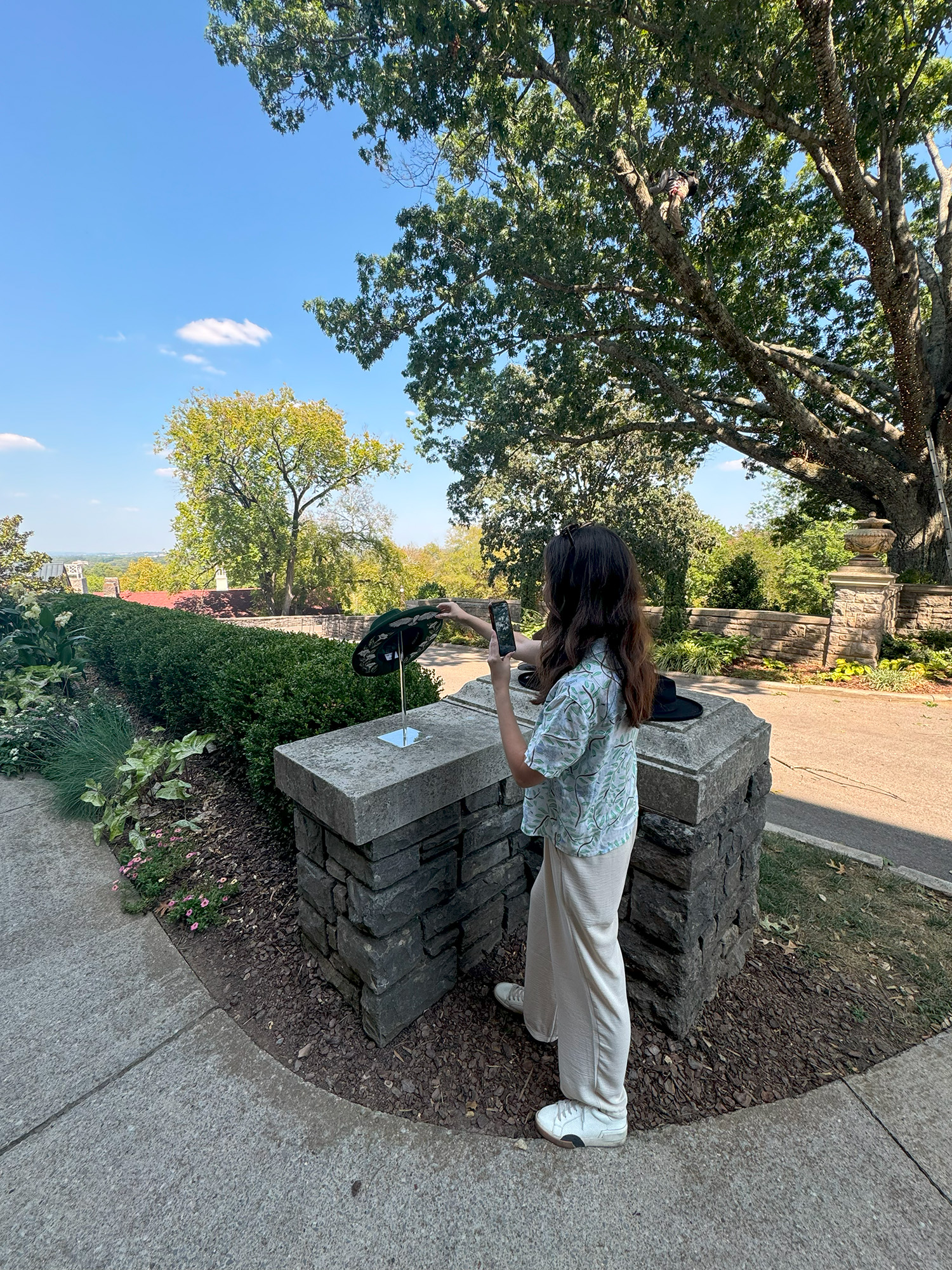
At Cheekwood, every day brings a new adventure, which keeps things exciting! My routine includes exploring the gardens and Mansion to capture stories and footage, assisting with photo shoots, and photographing new items or sales in the Garden Shop and Museum Shop. I cover events by taking photos and videos, posting live stories on social media, and editing and scheduling content. Additionally, I create Facebook events, research trends, analyze digital analytics, and compile monthly social media reports.

Photo 4_Japanese Garden
Photo 5_Joanna Working

Photo 2_Joanna Intro

What is your favorite part of working at Cheekwood?

I absolutely love working at Cheekwood, so choosing one favorite aspect is difficult. A standout moment for me was shadowing an artist interview during the installation of the new INTERVENTIONS art exhibition at the Mansion. Meeting the renowned British artist Ann Carrington, shaking her hand, and hearing her discuss her work in person was an unforgettable experience. Another highlight is working events like Thursday Night Out, Dog Nights of Summer, and the Under the Stars Concert Series. I was fortunate to be involved in every Dog Nights of Summer and Under the Stars concert, and I’ve seen firsthand the thought, effort, and energy that go into each event. As my time here comes to a close, I’m feeling bittersweet. The sentiment ‘Once you’re Cheekwood family, you’re always Cheekwood family,’ truly encapsulates what makes Cheekwood so special. Regardless of the role you play, big or small, you make a difference here. Thank you to everyone for your kindness and support throughout my journey at Cheekwood.


test

Volunteer Spotlight: Alison Wilms


Alison supports Cheekwood in so many different ways. She loves to try different volunteer assignments, always with curiosity, embracing the opportunity to learn something new. Serving at cultural and seasonal events, concerts, children’s activities, education programs, art exhibitions, conservation and gardening projects, along with community outreach, she finds joy in taking advantage of a myriad of volunteer opportunities that Cheekwood has to offer. Alison is a true ambassador for Cheekwood, her enthusiasm creates excitement, and her cheerful welcome enhances every encounter. She is a champion of promoting the volunteer experience and embodies what it means to serve.


Tell us a little about yourself and your background.

I grew up and went to college in Ohio for social work. I started out my career there and then traveled to different countries doing some volunteer and mission work. After coming back to the States, I’ve lived in Ohio and Florida prior to moving to Nashville. I moved here almost 5 years ago and have loved discovering Cheekwood and all Nashville has to offer.

What are your favorite hobbies, activities, or interests?

I enjoy hiking, traveling, and volunteering/being involved in my community; as well as, being out in nature and reading a good book. And of course, spending time with family and friends.

What is your favorite garden or area at Cheekwood and why?

The Robinson Family Water Garden. I love being by the water and there are benches or tables to be able to sit and read or journal or chat with others or just to be still. You can also still see the beauty of some of the surrounding areas.

Do you have a favorite artwork at Cheekwood, or, if not, a favorite exhibition that Cheekwood has hosted? Is there a reason you like it?

I’ve enjoyed the outdoor exhibits like Bruce Munroe and the new troll exhibit. And inside the mansion, I really loved the exhibit from Sarah Nguyen.

In what ways have you been involved as a volunteer with Cheekwood so far?

I’ve helped out in various ways over the past year or so. I’ve helped with the different events as a greeter or in the children’s activities. With the Holiday Lights, I helped put together the s’more boxes, was a door greeter to the mansion, a Santa line guide, and also helped with the gift shop.  I’ve also helped with the “Weed Wrangle” in the Spring and helped at the Cheekwood booth at different outreach events.

Why did you decide to become a volunteer?

I volunteered with Cheekwood starting a little over a year ago through Hands on Nashville. I work from home and was looking for ways to get out into the community. I enjoyed being there the day I volunteered and another volunteer talked about signing up to volunteer with Cheekwood directly so I decided to do so that day!

What have you enjoyed the most about your volunteer experience?

Being able to enjoy Cheekwood, all while getting to interact with others. And getting to know the other volunteers and staff.

Is there a funny or inspirational story you can briefly tell about your volunteer experience?

It’s great seeing all the cultural events and how Cheekwood is for everyone. Helping with some of the kids activities, you can see the care Cheekwood staff puts into planning as it isn’t just for fun but also educational. It’s been fun to be a part of and see adults wanting to take part as well.

Do you have any advice for individuals considering volunteering with Cheekwood?

Do it. Even if through Hands on Nashville to see if you like it and want to get involved more. Talk with Amy (the volunteer coordinator) or any of us volunteers – we’d be happy to answer any of your questions.

For more information about volunteering visit our volunteer web page: www.cheekwood.org/support/volunteer

test

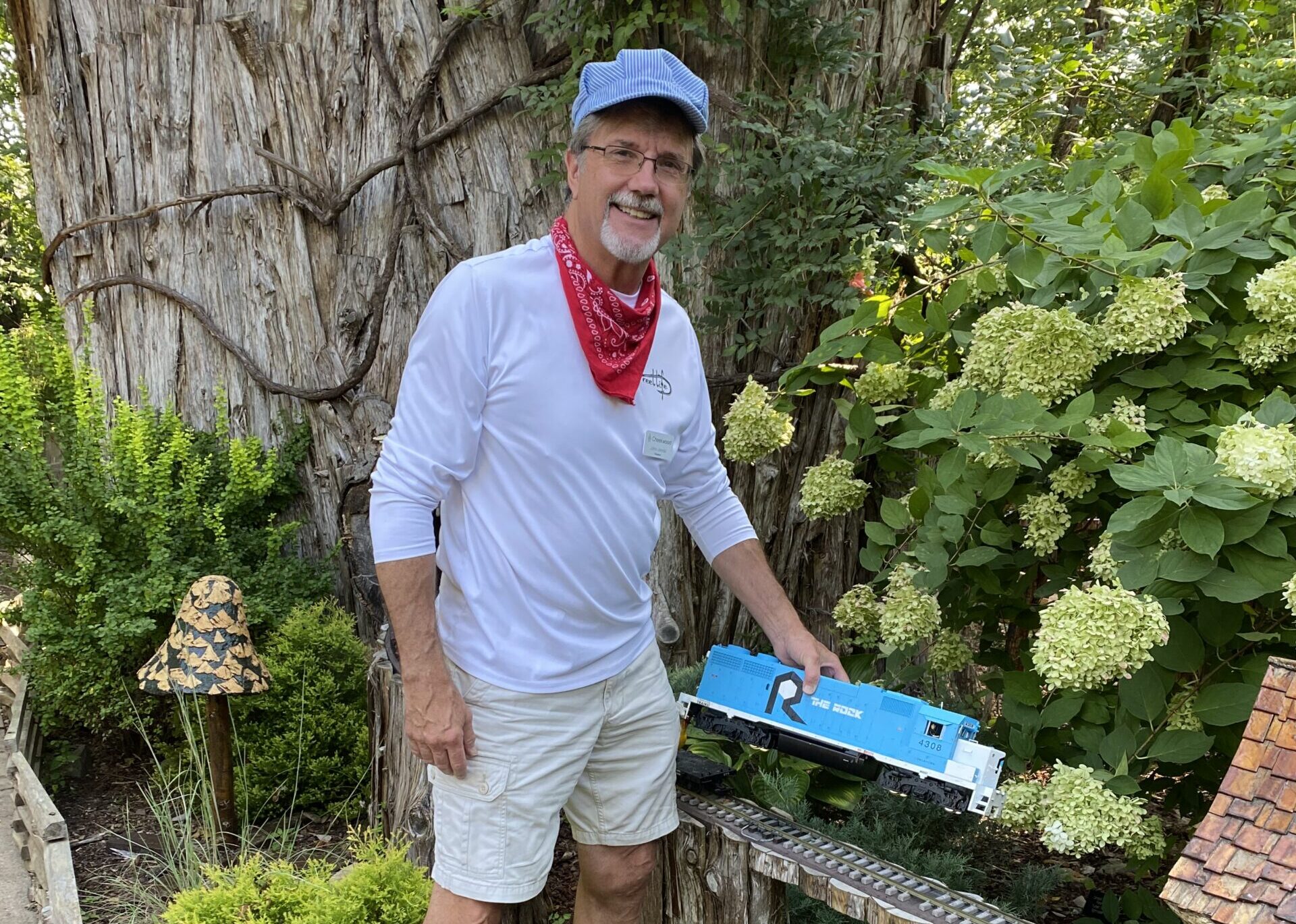
Volunteer Spotlight: John Joniak


John Joniak embraces any assignment with enthusiasm and a smile. He participates in many of Cheekwood’s events, but his passion is working on our miniature trains exhibit. Most weeks he can be found at trains, tidying up the tracks, working on the train cars, and keeping the exhibition area clear of debris. But his favorite thing about the trains is to share fun facts with our guests, big and small.


Tell us a little about yourself and your background.

I’ve been married to my wife and best friend, Christine, for 48+ years! We lived most of our lives in Naperville, Illinois, a suburb 20 miles west of Chicago. We have 5 wonderful children and 6 terrific grandkids. Five years ago we retired and moved to Tennessee where we established new roots in the Nashville area and absolutely love it here! <br><br>Before I retired, I worked initially as a product engineer and then as a regional or national sales manager for various manufacturing companies.

What are your favorite hobbies, activities, or interests?

My wife and I love spending time with our kid’s & grandkids, being involved with our church, traveling, playing pickle ball, socializing with friends, and going bike riding on Tennessee’s beautiful green ways! I also like fishing, kayaking, exercising on my rowing erg and volunteering, especially at Cheekwood!

What is your favorite garden or area at Cheekwood and why?

It has to be Cheekwood Trains! My dad and I had a Lionel model train set back when I was growing up. We spent many a day working side-by-side building and playing with the train layout! I find the Cheekwood Trains exhibit absolutely MAGICAL! Anyone who likes model trains or enjoys being in an enchanted place that makes you feel like you’re in a fairy tale world, would love the Cheekwood Trains exhibit!

Do you have a favorite artwork at Cheekwood, or, if not, a favorite exhibition that Cheekwood has hosted? Is there a reason you like it?

My favorite Cheekwood exhibit or event would be Holiday Lights! They do such an amazing job decorating the entire grounds, including Cheekwood Trains!

In what ways have you been involved as a volunteer with Cheekwood so far?

I have been volunteering at Cheekwood for two years now. Although I have spent many hours helping in the various gardens, most of my time is spent coming in each week to help maintain the trains exhibit…scrubbing the tracks, rotating and cleaning the contacts on the engines, and switching up the theme cars. While I’m there, I also enjoy engaging with the enthusiastic kids (and adults) many of which come to Cheekwood specifically to see the trains. When time permits, I pull a spare Thomas the Tank Engine out of the roundhouse and do an impromptu show and tell with the young visitors!

Why did you become a volunteer?

Being retired I have plenty of time on my hands and like to keep active. I enjoy helping and meeting people and also love the outdoors & working with my hands so Cheekwood is a perfect choice for me!

What have you enjoyed the most about your volunteer experience?

There are several things that I love about volunteering at Cheekwood...I enjoy my serene walks through the gardens, appreciating their beauty during my walk to the Trains. It helps me connect to nature as well as to God! I thoroughly enjoy meeting and engaging with the visitors that I meet, especially the children! That can also be said for the Cheekwood employees (gardeners, managers, etc) and the other volunteers that I’ve met. They are all wonderful people!

Is there a funny or inspirational story you can briefly tell about your volunteer experience?

I love the pure joy of the “little” visitors that I meet! Their excitement, abundant energy and sheer happiness is truly contagious!

Do you have any advice for individuals considering volunteering with Cheekwood?

If you have time on your hands, enjoy nature, like helping others, and/or meeting or working with friendly people… Don’t give it a second thought! Inquire about the many volunteer opportunities that Cheekwood has to offer! You won’t regret it!

For more information about volunteering visit our volunteer web page: www.cheekwood.org/support/volunteer

Privacy Policy Sitemap Web design by Speak
Back to top